
How strategy becomes practice
Positioning, customers and GAP, objectives and KPIs, resistance tests, strategy, operations and three concrete tests: the process that aligns concepts and tools within a business discipline. Line up…
Condividi questo articolo:
Positioning, customers and GAP, objectives and KPIs, resistance tests, strategy, operations and three concrete tests: the process that aligns concepts and tools within a business discipline.
Line up what you need
In the two previous articles we built the ingredients.
Now let's line them up.
Process is the last of the three pillars in this series, and it is what transforms marketing from a notion into a discipline.
We work in phases.
Positioning: who you are, who you are for
Positioning is the answer to a question that seems simple but isn't: who are you, and who are you for?
Let's start with "who you are".
The first: who are you?
The second: what are your characteristics?
The third: what products and services do you offer? Precisely what you offer — and therefore also what you don't offer — is the first step towards a legible professional presence.
The fourth: what is special or unique about these products?
The fifth: why should a client involve you in their events?
Once the five questions are addressed, the anatomy of positioning can be summarized into three components.
Target — who you serve.
Promise — what you offer.
Differentiation — why you.
To concretely understand what we are talking about, two examples at the antipodes of the market, both fully legitimate.
A Luxury Craftsman.
A Digital Enterprise.
Two different positionings, two different strategies, two different successes.
Customers and GAP: where you are, where you want to go
Once you know who you are and who you are for, the next stage is to look at who currently chooses you and compare it to who you would like to choose you.
The current customer.
The contact register.
CRM — Customer Relationship Management.
Turnover by cluster.
The post-event interview.
The desired customer.
Which cluster would you like to serve more?
What average ticket would you like to reach?
What margin do you need to grow and how do you intend to achieve it?
What type of event would you like as a centre?
The GAP. of Luxury, GAP composed of visual positioning, partnerships with prestigious locations, contents dedicated to long-term planning.
How do you close a GAP? they are often the time needed not to see the effects of a repositioning, but simply to put into practice the actions linked to that repositioning.
Objectives and indicators: what you want, how you measure it
This is the chapter that separates real strategies from loudly expressed aspirations.
Let's start with a rule of method: the objectives must be few and measurable.
Example of a 12-month goal: increase turnover from international weddings by 30%.
A primary KPI.
A secondary control KPI.
For more structured organizations, there is an alternative framework — more sophisticated and, in our opinion, more realistic in growth contexts.
The logic is similar but richer. detection of the approach to the Objective.
The practical difference between KPIs and OKRs?
Endurance test: three comparisons before leaving
Once an objective has been defined, before transforming it into a strategy, it must be subjected to three comparisons.
First comparison: with the reality of one's own resources.
Second comparison: with competitors. analytical exercise in itself.
Third comparison: with the market. a concerted market between twenty-five areas of specialization: operators in the same niche, even if in different categories, influence each other.
Case of a lens that fails the test. questioning, but negative in the overall balance.
A positive resistance test does not guarantee success.
The strategy: three tools for three types of decisions
Once you have defined the objective that passes the test, you enter the heart of the strategy.
The TIMER, already seen in the second article.
The Pareto principle, also already seen.
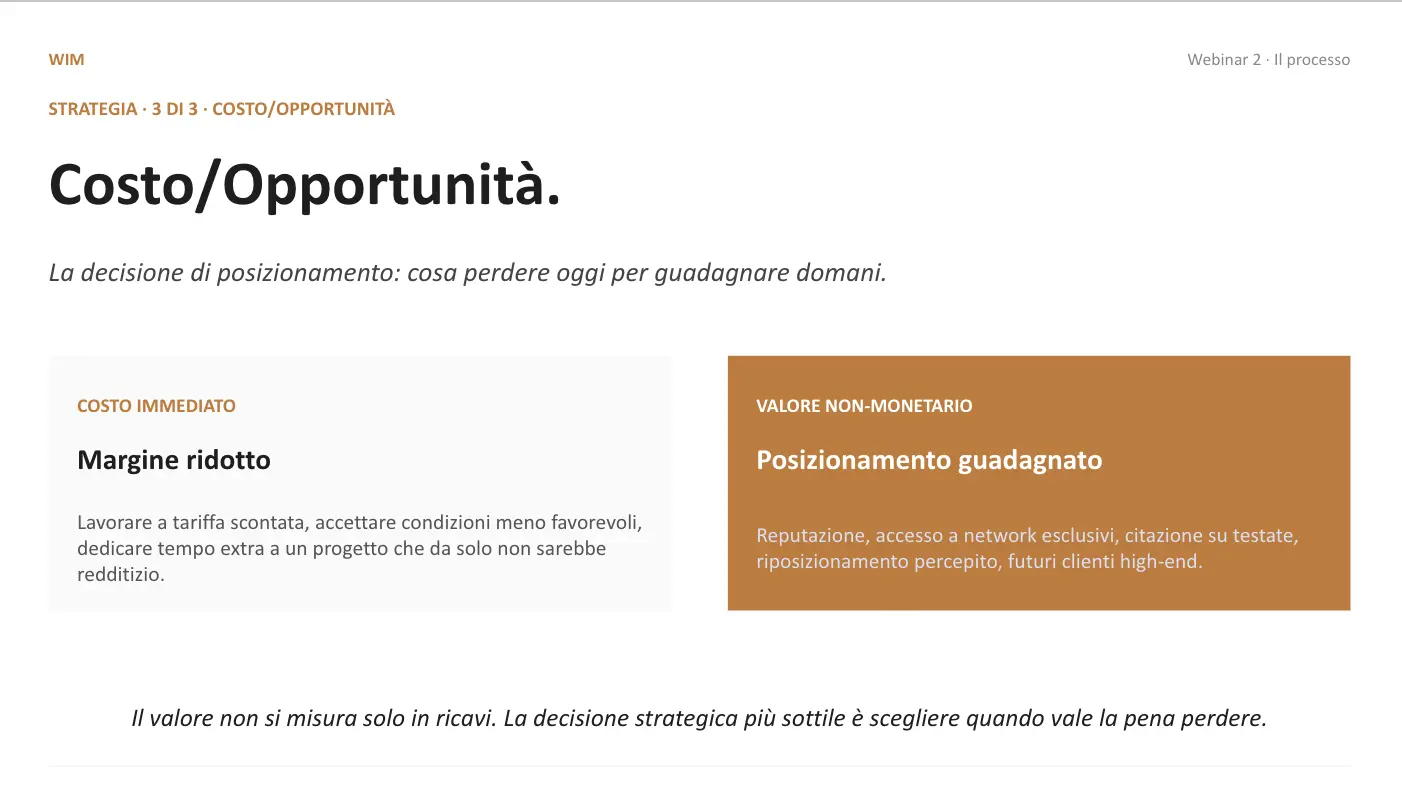
The opportunity cost principle.
The opportunity cost applies when an operation, taken individually, seems to lose or break even, but generates an important non-monetary value for the future: reputation, access to exclusive networks, mention in prestigious publications, perceived repositioning, future high-end customers. over the entire trajectory of the brand over the next five years.
Pay attention to one important thing: a strategically successful operation on the cost-opportunity may not pass the TIMER.
Operation: from strategy to weekly action
At this point you have positioning, gap, objectives, KPIs, strategy.
We work on three operational levels: content creation, distribution, sales.
Content creation.
The editorial calendar.
Repurposing. intercepted, the same core content remains.
Quality over quantity.
Distinctive brand assets.
Distribution. monthly, blog two to four times a month. benchmark orientativi — must be calibrated to your truly sustainable capacity.
It's not enough to pay for content to arrive, strong organic work is also needed.
Measurement: each channel can be monitored through different indicators, but it is useful to identify a few truly decisive metrics.
Sales.
Lead qualification.
The speed of response.
Negotiation consistent with positioning.
Three tests: tactics, strategy, vision
To close, three real examples.
Try one, tactic.
CRM — Customer Relationship Management — is not just software.
The mechanism is simple. appreciate what we do?". It seems trivial, and produces extraordinarily different results from those who don't do it. Track: record the suggested contacts. Measure the conversion rate of the activated word of mouth. Periodically contact the customers who have proven most generous in recommending you.
The basic lesson: you don't wait for word of mouth.
Try two, strategic.
The case is in the public domain — Costanza Giaconi of Bianco Bouquet, WIM ambassador, and Castello di Rocca Cilento spoke about it openly at the WIM Event 2024. Let's summarize the facts.
A few years ago Bianco Bouquet agreed to organize the Westwick wedding, at the Rocca Cilento Castle.
Why do it?
White Bouquet.
Rocca Cilento Castle.
The lesson, in terms of process: when the opportunity cost is positive, reduced margins can be accepted for high positioning. of our market.
Try three, vision.
What WIM is trying to do with the private events market is what the MICE market - Meetings, Incentives, Conferences, Exhibitions, the world of congresses - did thirty years ago.
How did he do it? market rises when know-how is shared, not when it is withheld.
The final lesson: The perceived value of an industry only grows if the industry acts together.
The complete map
To close this series, it is worth stopping for a moment and looking at the whole thing.
We went through concepts that help to read the market: the funnel, the Messy Middle, the WIM clusters, Cialdini's principles, generational differences.
We then focused on the tools: contents, channels, distribution, TIMER, Pareto.
Finally, we reconstructed the process: positioning, customer and gap analysis, definition of objectives and KPIs, resistance testing, strategy, operations, content, distribution, sales and verification through three concrete tests.
This is the overall photograph.
The role of WIM also fits into this path.
The WIM ecosystem was born from a simple belief: the single operator, alone, can do a lot, but cannot do everything.
The structure exists.
Continua a leggere...
Questo contenuto è riservato. Accedi alla nostra piattaforma per leggere l'articolo completo.
Prosegui su WIM for ProRead more...
This content is for members only. Log in to our platform to read the full article.
Proceed to WIM for ProCondividi questo articolo:

Diventa un
Digital Wimmer
Contenuti esclusivi, community e accesso anticipato agli eventi — tutto in un unico posto.







WIM For PRO · Where Ideas Meet
Sei già un
Digital Wimmer?
Community
Forum, directory e networking tra i professionisti del settore
Insights PLUS
Report esclusivi, WIM Survey e contenuti editoriali riservati
Priorità eventi
Accesso anticipato a tutte le tappe Tour, Talks e WIM Event
WIM For PRO · Where Ideas Meet
Are you already aDigital Wimmer?
Community
Forums, directories, and networking among industry professionals
Insights PLUS
Exclusive reports, WIM Surveys, and exclusive editorial content
Event priority
Early access to all Tour, Talks, and WIM Event sessions
Tutti i dettagli relativi ai vantaggi delle membership e al pricing dell’evento sono disponibili nel kit evento. Per qualsiasi necessità, assistenza o richiesta di approfondimento, puoi contattarci in qualsiasi momento scrivendo a info@wimforevents.com