
The Indian market is not just a market. It is a continent.
Why the Indian wedding — in India and across the diaspora — is one of the biggest economic drivers of the global wedding industry, what families choosing Italy really want, and what sets apart those…
Condividi questo articolo:
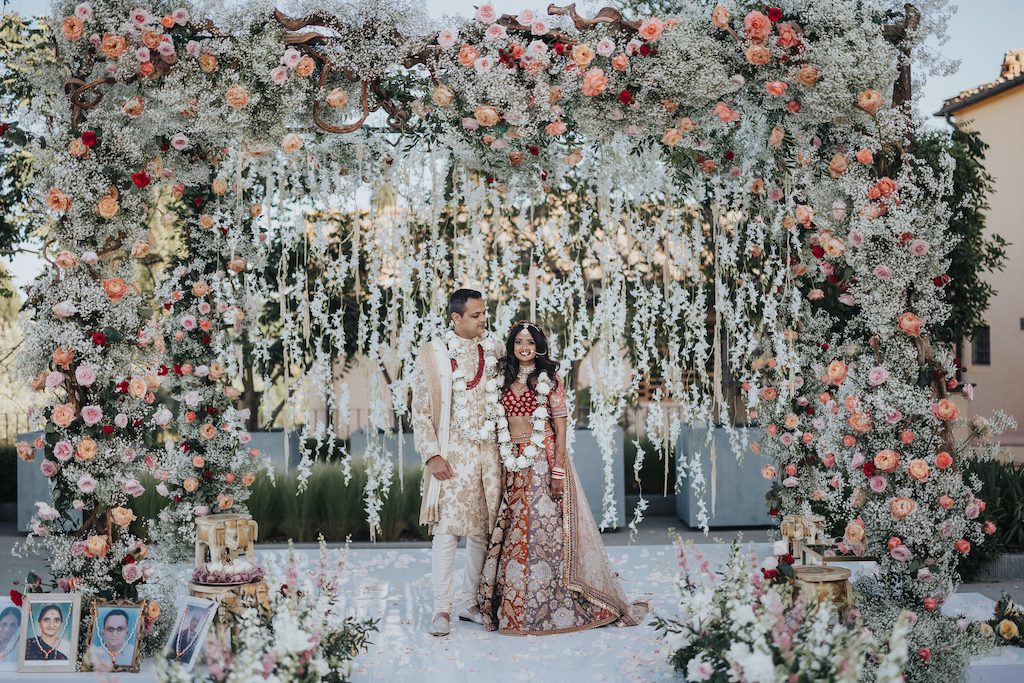
Why the Indian wedding — in India and across the diaspora — is one of the biggest economic drivers of the global wedding industry, what families choosing Italy really want, and what sets apart those who get booked from those who get left halfway through the quote. From the third webinar in the WIM Insights 2026 international markets series, featuring Costanza Giaconi (Bianco Bouquet).
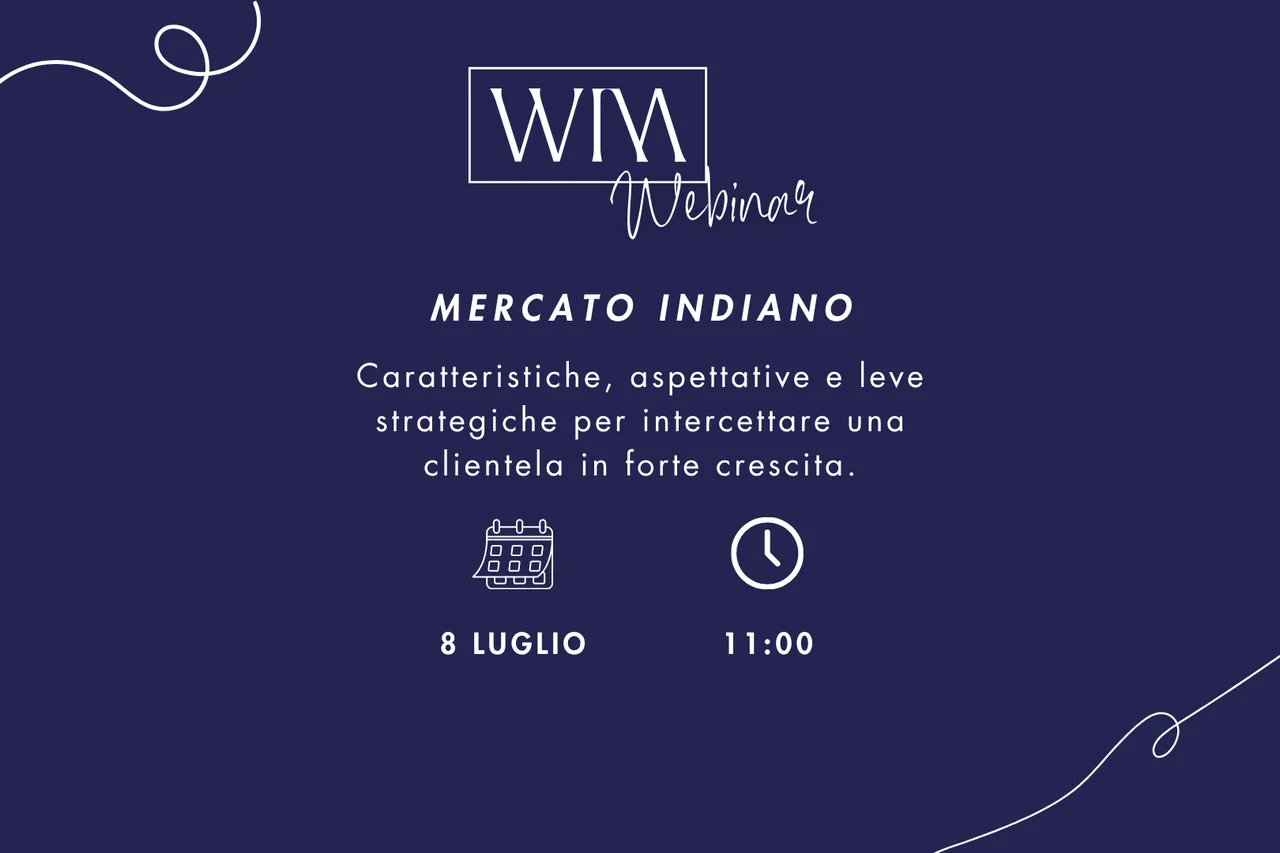
On July 8th, we dedicated the third appointment of our WIM Insights international markets series to the Indian market. Our guest was Costanza Giaconi, founder of Bianco Bouquet, who has dedicated over ten years of focused work to the high-end destination Indian wedding segment, including a stable partnership in India since 2021 and a presence as an ambassador at the Vogue Wedding Atelier.
Costanza got straight to the point with a premise that is well worth placing right at the opening of this article, because it conditions everything that follows: saying "the Indian wedding" is like saying "the European wedding". India is not a market — it is a continent. Thirty-plus states, dozens of religions, forty-five different languages, cuisines in the north that have nothing to do with those in the south, and ceremonies that change entirely depending on the family. And today, high-profile Indian clientele no longer live only in India: they live in London, New York, Toronto, Dubai, and Singapore. A geographically distributed, culturally cohesive, and economically massive market.
It was a dense webinar, packed with data, operational examples, memories of past weddings, and a couple of figures that any Italian professional looking to enter this niche should print out and keep in their office. Here is the complete picture, laid out in the order it was addressed.
Five things to focus on before getting started
Costanza opened with a list of five coordinates that are worth making explicit from the start, as the rest of the conversation built upon them.
The first one we have already anticipated: the Indian wedding does not exist in the singular. Thirty states, profoundly different cultures, completely distinct cuisines, separate rituals. When an inquiry arrives, the first serious question is: where do they come from? Not just geographically, but culturally and religiously. Sikh, Hindu, Jain, Christian, multi-religious — every combination rewrites the event.
The second: astrology truly matters. The muhurta is the auspicious time for the ceremony. It is not decided by the planner, it is not decided by the couple, it is not decided by the families. It is decided by the priest. It is non-negotiable. If the muhurta falls at 8 AM, the ceremony is at 8 AM — and all other logistics reorganize around that. To give you a sense of scale: last November 23rd, thanks to a particularly favorable muhurta, over 10,000 weddings were celebrated in a single day in the New Delhi region alone.
The third: you do not work with a couple; you work with a family. This is a cultural trait we share with the Arab world—which had already emerged in our webinar with Samar—but much less so with North America. In India, the couple rarely makes decisions alone. The family decides — often multiple families together — and an Indian planner, a family office, or a personal assistant frequently works alongside them. The first useful step, even before talking about quotes, is understanding who actually approves the budget and who makes the decisions.
The fourth: every religion completely changes the organization. It changes the structure of the ceremony, the role of the priest (Pandit, Granthi, or other figures), the rituals (the sacred fire in Hindu ceremonies, the Guru Granth Sahib in Sikh ceremonies), dietary requirements (strict vegetarian for Jains, halal for Muslims, the absence of alcohol in many contexts), and the schedule. There is no one-size-fits-all format. There isn't even a single playbook that applies to everyone.
The fifth is probably the most counterintuitive for anyone approaching this market: the diaspora does not mean westernization. The idea that an Indian couple born in London or raised in New York expects a "more Western" wedding is wrong. On the contrary: very often, a destination wedding becomes the perfect opportunity to celebrate one's cultural identity with even greater care, bringing forward traditions that are less expressed in their country of residence. The job of the Italian planner and vendors is not to "adapt" the wedding to Western culture — it is to create a balance between two worlds. And then there is an important operational detail: no one expects us to know what the pandit is saying in Sanskrit during the rite. Nobody knows, often not even the bride and groom. What is needed is knowing what the venue, vendors, and logistics require — not knowing the text of the ritual. Sincere interest combined with transparency about what you don't know is appreciated much more than flaunting superficial knowledge.
The Market
Numbers. The wedding industry in India is worth around 50 billion dollars a year. If you include all related sectors — clothing, jewelry, hospitality, travel, luxury — some estimates exceed 100 billion. It is one of the largest sectors of the entire Indian economy. It is not a colorful detail: it is a primary economic sector.
The reason is not just demographic. In India, a wedding carries a social, family, and cultural weight that we in Western countries struggle to imagine. Families save for a lifetime to organize lavish weddings, and this holds true across all social levels. A wedding is a celebration of life and the moment a family shows their community and themselves what they are capable of. It is a family investment, a social investment, and a cultural investment — all wrapped into one.
The clientele is not concentrated solely in India. The Indian diaspora has massive communities in the United Kingdom, the United States, Canada, the United Arab Emirates, and Singapore. These are the main hubs, but the distribution is even more widespread. This opens up a strategic consideration worth highlighting: for an Italian company wishing to position itself in the Indian market, advertising in India is not necessarily essential. You can intercept the same high-profile, high-spending, culturally Indian clientele through entirely Western channels. Instagram, first and foremost, which we will discuss later.
When it comes to Indian destination weddings specifically, the numbers are just as significant. The segment is worth around 18 billion dollars in 2026, with an expected annual growth of around 15%. In 60% of high-budget weddings (in India, a high budget means one crore — around 100,000 dollars, a figure that locally buys a massive event, but much less abroad), families choose to get married outside the country. Sixty percent. A data point that alone justifies the strategic attention the Italian market should dedicate to this niche.
What they really want from a destination wedding in Italy
Italy is not the natural choice — it is one choice among many. And the others include Thailand, Indonesia (Bali), Turkey, the United Arab Emirates, and other Asian destinations. Some are geographically closer, and all have a well-oiled supply chain for Indian weddings. Italy competes on six concrete parameters, which Costanza went through one by one.
Guest logistics. Direct international flights, international airports close to the location. Italy is generally well-connected, but some regions have a clear structural advantage over others. Villas that are too far from main airports start with a handicap.
Spacious venues. The numbers are large, even when they scale down. Spaces are needed that can host multiple days of events, with the capacity for multiple and simultaneous setups. A villa for 60 people rarely makes the shortlist for an Indian wedding.
Scenic setting. Not so much the museum or the historical-cultural wealth. When it comes to Italy, the landscape wins — the postcard views, nature, resorts surrounded by greenery. A point Costanza highlighted from direct experience: even when there are 200 guests, the schedule rarely includes structured cultural tours. The postcard is outside, the party is inside. Tuscany and Lake Como are, not surprisingly, the most well-known and requested destinations — thanks in part to the celebrity weddings celebrated there over the years.
Perception of exclusivity. Families also choose destinations based on who got married there before. It is a logic of prestige that must be understood: a celebrity reference is not superficial vanity; it is a tangible element of the destination's reputation. If an Indian or international public figure got married in a villa, the perceived value of that villa changes.
Ease of visas. This is where Italy — and Schengen Europe more broadly — starts at a disadvantage. Visas for Indians are complicated, requiring embassy appointments, long and sometimes uncertain timelines. For a wedding with 600 guests, Europe is often excluded from the start in favor of Thailand or Indonesia, which offer visas on arrival. I will return to this shortly: it is an operationally crucial point.
Structured and specialized vendors. This is perhaps the leverage where Italy can play its best cards. No culture needs to be reassured as much as Indian culture. Indian clients feel at peace if planners, vendors, and photographers have already worked on Indian weddings. Having specialized vendors — priests, dhol players for the baraat, henna artists, Indian caterers, choreographers — radically changes Italy's position in the competition with other destinations. Good news: there is an Indian community in Italy that exceeds 200,000 people. The supply chain exists. It just needs to be known.
The visa: the operational risk that no one sees until it is too late
This deserves its own paragraph because it is a concrete operational risk that can ruin events that are already set up. Culturally, Indian families tend to send out invitations just a few months before the event — while the planning process started 9-12 months prior. If a wedding takes place in June and the family sends invitations in March, guests will ask for an embassy appointment in April for a issuance that might arrive in late May. If it doesn't arrive in time, the guest won't travel. If it doesn't arrive for enough guests, the wedding falls through.
What can the Italian vendor do to mitigate this risk on their own initiative and in a structured way? First: raise awareness with the family right from the start, asking for at least a save-the-date to be sent well in advance, even without finalized information. Second: prepare to produce official invitation letters with stamps and letterheads, in collaboration with the venue, in a fast and repeatable way. Third: prepare a standardized form to collect guest data (name, passport, city of residence) and produce letters in bulk. This looks like an administrative task, but it becomes a competitive differentiator. There have been advanced negotiations — with deposits already paid — that ended without a wedding because visas did not arrive in time. Those who know the risk prevent it.
Guest numbers: why they are dropping (and what it means for us)
In India, weddings with between 600 and 2,000 guests are normal. Costanza shared a story about a wedding in India with 5,000 people — where the bride and groom didn't even talk to the guests; they just took a photo with everyone. Hours and hours of lines.
In destination weddings in Italy, the numbers drop, and they are continuing to drop. Today, the average stands at around 150-300 guests; the trend is downward, toward 150 and below. Some reasons are structural (visas, flight costs, logistics), others are cultural: younger generations tend to prefer more exclusive and curated experiences over large numbers; they have a more Western aesthetic in this sense. A natural 10% drop due specifically to unobtained visas must also be factored in.
This data point has a significant commercial consequence: the Indian destination wedding is progressively shifting from a "mass" event to a "curated extended family" event, with budgets concentrated on fewer people. For Italy, this is an opportunity: our high-end offering is designed precisely for numbers of this scale.
Not one day, but three. And they are all the wedding.
In North America, a classic destination wedding spans three days: welcome dinner, wedding, Sunday brunch. It lasts three days, but there is only one wedding day — the other two are just a frame.
In an Indian wedding, three days is the bare minimum. And it's not one wedding day plus two side events. It is three days of wedding. Every day features rituals that, combined, make up the event. The American-style welcome dinner is called Mehndi here, and it is not a dinner — it is a ritual.
Costanza emphasized the operational scope of this difference. We aren't talking about a welcome dinner with a five-hour setup. We are talking about events. Morning, lunch, afternoon, evening. For three days. The commitment for the company is totally different, and this changes contracts, price lists, and human resource management.
It is worth going through ritual by ritual.
Mehndi
The ritual of applying henna. Historically reserved for women, today all guests participate in destination weddings. It is often combined with the welcome dinner and becomes the wedding's opening event. A dedicated artist for the bride — who spends 4-5 hours getting her arms, hands, ankles, and feet tattooed — and multiple artists for the other guests (about half an hour per person for hands).
Setup: colorful, convivial, immersive. Lounges, ambient music, Indian street food, and stations for the henna artists. Culinary detail: at Indian weddings, food is almost always buffet-style, and the buffet is almost always Indian — not just for taste, but to serve guests who may travel less and need to find the comforts of home. Italian pizza, however, always wins; it is the allowed variation to the rule.
Sangeet
The most spectacular event. The ritual is dancing. Families celebrate each other through choreographed dances prepared for months — often with the help of professional choreographers. On the dancefloor, 5, 8, or 15 people dance simultaneously. The bride, groom, and families prepare dedicated performances.
The operational implication is precise: the evening doesn't revolve around dinner; it revolves around the performances. The buffet stays open for 5-6 consecutive hours, without a set dinner time. Guests serve themselves in the 10-minute intervals between performances. A proper stage, high-level audio and lighting, precise technical timing, and careful direction. The menu is Indian — this is not optional.
Haldi
Friends and family apply a turmeric paste to the face, arms, and legs of the bride and groom. It is a symbol of purification, protection, and prosperity. Traditionally celebrated the morning of the wedding itself, in destination weddings—if the muhurta is very early—it is moved to the day before.
Important operational focus: after the ritual portion, it is not uncommon for guests to get actively involved, throwing petals, water, or extra turmeric at the couple. The location must be easy to clean, and the venue must be informed in advance about the ritual's characteristics. It is one of the most spontaneous and fun moments of the entire wedding.
Wedding Ceremony
Here, differences between families are at their maximum — religion, region, and family tradition change the rituals, duration, and symbols. Some recurring elements: the Mandap, the decorated structure under which the ceremony takes place; the presence of the priest (Pandit for Hindu ceremonies, Granthi for Sikh ceremonies); the sacred fire in Hindu ceremonies; the Guru Granth Sahib in Sikh ceremonies.
The schedule is often decided by the muhurta — so potentially at dawn or in the morning. This is followed by a lunch that is generally vegetarian and alcohol-free. Precise knowledge of the ritual is not required from the vendor; knowledge of the logistical requirements is — if there is a sacred fire, the venue must be able to host it; if there are dietary restrictions, the caterer must respect them.
Reception
The most international moment of the wedding, where the bride and groom express their personal taste the most. While retaining elements of Indian tradition, the aesthetic opens up. Scenic setups, live performances, international music, DJ sets, and live bands. The party doesn't end with the cake — it continues into an after-party.
Regional differences: three examples
Costanza brought three examples to show how much a wedding changes depending on the region of origin. Punjabi (north, Sikh and Hindu) — very large, very spectacular, DJs, dhols, Bollywood, and Bhangra, rich and varied cuisine, festive energy. Gujarati (north-west, Hindu and Jain) — large but more organized, elegant and traditional atmosphere, cuisine is often entirely vegetarian. Tamil (south, mainly Hindu) — more contained, highly symbolic, solemn ceremonies with traditional southern music (nadaswaram), southern Indian cuisine — traditionally served on a banana leaf, which in Italy is replaced by silver trays.
A note on commercial reality: the majority of Indian destination weddings in Italy come from Punjabi families. Tamils remain culturally more rooted and tend to marry close to their community, often in temples. If a request for a Tamil destination wedding in Italy arrives, it is a rare event.
The business: how to truly work with Indian clients
Five elements that condition every negotiation.
The decision maker. Traditionally, the wedding was financed almost entirely by the bride's family; today, especially in the diaspora, costs are increasingly shared between both families. The points of contact can be many: the couple, the parents (on both sides), brothers and sisters, an Indian wedding planner, a family office, or a personal assistant. The first step is to map out who decides what. Without this map, processes drag on for months over single design or vendor choices.
Negotiation is culture. It is not a lack of trust, nor is it a disregard for your work. It is simply how many Indian clients are used to doing business. A detailed quote with explicit line items, value communicated beyond the price, economic consistency maintained over time, and transparency are tools that build trust much more than discounts. Lowering the price opens the door to comparison with another vendor; explaining the price closes the deal.
The Italian context must be explained. Indian families are used to labor costs that are much lower than European standards. The cost of specialized staff, overtime, night work, Italian labor regulations, logistical costs — all of these things must be explained explicitly from the very first contact. At the same time, it must be understood that culturally they expect many people dedicated to service during events — so staffing levels must be generous. Costanza recalled a wedding with 100 different buffet varieties: these are real expectations of service richness, not whims.
The Indian planner and the Italian planner are complementary roles. More and more families rely on an Indian planner even when the wedding is held in Italy. The local planner, however, remains indispensable. The Indian planner manages the culture, rituals, family dynamics, and upstream mediation. The Italian planner manages venues, Italian vendors, logistics, permits, and downstream cultural mediation. Collaboration between the two is often the most effective formula; the mistake is viewing them as competitors.
Speed and flexibility. Indian families, especially when guided by professional planners, are used to rapid paces. A quote sent after a week can already be too late. WhatsApp is not an optional channel — just like in the Arab world, it is the primary workspace. Anyone who insists on managing everything via email risks being perceived as slow and unresponsive, and will be replaced. Voice messages, photos, videos, and real-time updates are the expected standard. And last-minute changes are normal: guest numbers, schedules, performances, setups, and times can all change. It is not disorganization — it is another project management model. Those who organize themselves to welcome it (while clearly defining what is modifiable and what is not, and within what timeframes) win.
The six mistakes that make you lose Indian clients
Costanza listed them in a row. It is worth presenting them with the same clarity.
One. Treating it like a normal destination wedding. This is the most frequent mistake. A photographer sending a standard quote for three days is making a mistake that is visible at first glance: a three-day American wedding means 5+8+3 hours, while a three-day Indian wedding means 14 hours a day. Proposals must be rebuilt from scratch.
Two. Saying "it can't be done". The Indian market rewards those who find solutions. There are technical and regulatory limits that must be respected, but the first response should never be a flat refusal. "Let's see how we can do it" opens the conversation; "It can't be done" closes it, often permanently. An Indian client who hears a no loses trust in the vendor and looks elsewhere.
Three. Underestimating last-minute changes. The timeline delivered weeks prior is not the final timeline. Those who do not organize to adapt quickly will not survive this market.
Four. Being too slow in communication. See above regarding WhatsApp. Those who take days to respond are replaced.
Five. Failing to explain the value of your work. The bare price is not enough. What is included, how many people will be working, how the service will be organized, what problems will be solved — everything must be made explicit. A justified price generates trust. A price without context generates unfavorable comparisons.
Six. Thinking that having a beautiful location is enough. A stunning villa is not sufficient. Families also choose based on the structure's availability, the flexibility of hours, the possibility to customize spaces, the staff's experience in managing complex events, and the quality of collaboration with planners and vendors. Costanza was blunt: you choose the villa where the owner proved to be flexible, not necessarily the most beautiful one. Hospitality matters as much as beauty.
How to get found
Instagram is the channel
For the Indian wedding market, Instagram is not a social network — it is the main engine of inspiration. Couples discover destinations, wedding planners, vendors, and photographers there. They save ideas for setups. They follow celebrity weddings. In India, TikTok is banned, which has further solidified Instagram as the reference platform. Well-curated reels of Indian weddings reach millions of views.
The Instagram profile of an Italian company looking to intercept Indian clientele must speak to Indians. Being present is not enough — you need content that appeals to that specific clientele: Indian weddings already done (photos, reels, behind the scenes), an aesthetic consistent with the Indian destination wedding imagery, and storytelling that touches upon the cultural side. If you don't have Indian weddings in your portfolio yet, you can create material through dedicated styled shoots, in collaboration with other vendors in the network — this is a strategy that has opened doors for several Italian companies over the years.
The B2B events that matter
Three appointments to know. The Exotic Wedding Planning Conference (EWPC) is probably the most interesting for anyone looking to work with the Indian market: Indian organization, a three-day conference, held in a different location each year (in 2026 it was held in Sardinia), with an audience made up of Indian wedding planners, hotels, venues, DMCs, and luxury suppliers. It is a true entry point.
The Vogue Wedding Atelier is an invitation-only event organized by Vogue India, dedicated to the luxury segment, held in India. Costanza is an ambassador — she can facilitate invitations for those who fit the profile. It is the place to observe high-end trends and meet designers, brands, and luxury wedding professionals. The DWP Congress (Destination Wedding Planners Congress) is one of the most important international events in destination weddings; the 2026 edition takes place in India in October — an opportunity to connect with local planners and vendors.
To be completely honest: some of these events have high participation costs. For companies in the market-opening phase, a complementary approach is to move through partnerships: look for international agencies, build clusters of specialized Italian vendors, and identify collaborations with circuits that already handle Indian clientele. As always, and according to the network logic, you don't get very far alone; with a good team, you build many possibilities.
On this note, an operational announcement that Costanza and Tommaso wanted to highlight: as with North America (with Megan) and the Gulf (with Samar), for the Indian market we are also inviting a few Indian agencies to attend the WIM Event in November in Florence. It is a concrete way to bring a piece of that Indian conference to Florence — at the cost of a WIM Event registration — which otherwise requires flights and significant budgets.
Indian media to know
Costanza selected four publications, and the selection is smart because it covers four different angles of the market. WeddingSutra is the country's most authoritative B2C wedding platform — the primary reference for Indian couples. South Asian Bride covers the Indian diaspora, particularly the UK and North America — anyone looking to intercept Indian clients born or raised abroad goes through here. Vogue India works on the luxury segment, celebrity weddings, and high-end trends. KushMag covers fashion, weddings, and lifestyle.
PR is a strategy, not a whim
Being published is not a finish line. It is the beginning of a strategy. Through publication, you increase business authority, trust, recognition, and selectability by Indian planners (who also choose vendors based on who has credible publications behind them). And it isn't always necessary to pay: where there is a great story to tell, content quality and narrative originality can open editorial doors without an advertising budget. You need well-built editorial material right from the start: high-quality photographs, an interesting story, cultural and design details, complete credits for all vendors, and a selection of images ready for submission. Magazines look for weddings that tell a story — not just events that look pretty.
Reputation, community, time
Toward the end of the webinar, Costanza condensed the logic of this market into a phrase that serves as a manifesto: in the Indian market, you don't sell a wedding, you build a reputation. Families talk to each other, planners constantly compare notes, and personal recommendations carry immense weight. A successful wedding generates opportunities for years. A mistake circulates very quickly.
The way into this market is time. When asked "how many years does it take to get a certain continuity of Indian clients?", Costanza's answer was: a couple of years of breaking in. Then growth becomes exponential — families talk to each other, planners suggest you, the first well-done wedding brings the second couple, which brings the third. Costanza does not advertise in India. The network grows on its own. Every wedding has 200 guests who know the family, and who in turn talk.
The flip side of the coin — which no one ever says, but is crucial — is the minimum budget required to execute an Indian wedding properly. Tommaso asked a blunt question: what is the starting budget for a three-day wedding for 200 people (events only, no hospitality)? Costanza's answer was precise: it starts at 800,000 euros, though it can come down to 600,000 if highly optimized. Below that, it is unthinkable.
This is a fact that must be spoken with honesty from a commercial perspective too, for two reasons. First, because it protects Italian professionals from stretching themselves into impossible quotes — we collected testimonies in the chat of weddings done for 400,000 euros "with backflips", and the comme...
Continua a leggere...
Questo contenuto è riservato. Accedi alla nostra piattaforma per leggere l'articolo completo.
Prosegui su WIM for ProRead more...
This content is for members only. Log in to our platform to read the full article.
Proceed to WIM for ProCondividi questo articolo:


Diventa un
Digital Wimmer
Contenuti esclusivi, community e accesso anticipato agli eventi — tutto in un unico posto.









WIM For PRO · Where Ideas Meet
Sei già un
Digital Wimmer?
Community
Forum, directory e networking tra i professionisti del settore
Insights PLUS
Report esclusivi, WIM Survey e contenuti editoriali riservati
Priorità eventi
Accesso anticipato a tutte le tappe Tour, Talks e WIM Event
WIM For PRO · Where Ideas Meet
Are you already aDigital Wimmer?
Community
Forums, directories, and networking among industry professionals
Insights PLUS
Exclusive reports, WIM Surveys, and exclusive editorial content
Event priority
Early access to all Tour, Talks, and WIM Event sessions
Tutti i dettagli relativi ai vantaggi delle membership e al pricing dell’evento sono disponibili nel kit evento. Per qualsiasi necessità, assistenza o richiesta di approfondimento, puoi contattarci in qualsiasi momento scrivendo a info@wimforevents.com