
Indian market: 10 steps to take before the next lead
A practical checklist for the Indian market. Things to do Monday morning — not in five years. The Indian market is one of the biggest economic drivers of the global wedding industry, boasting 18…
Condividi questo articolo:
A practical checklist for the Indian market. Things to do Monday morning — not in five years.
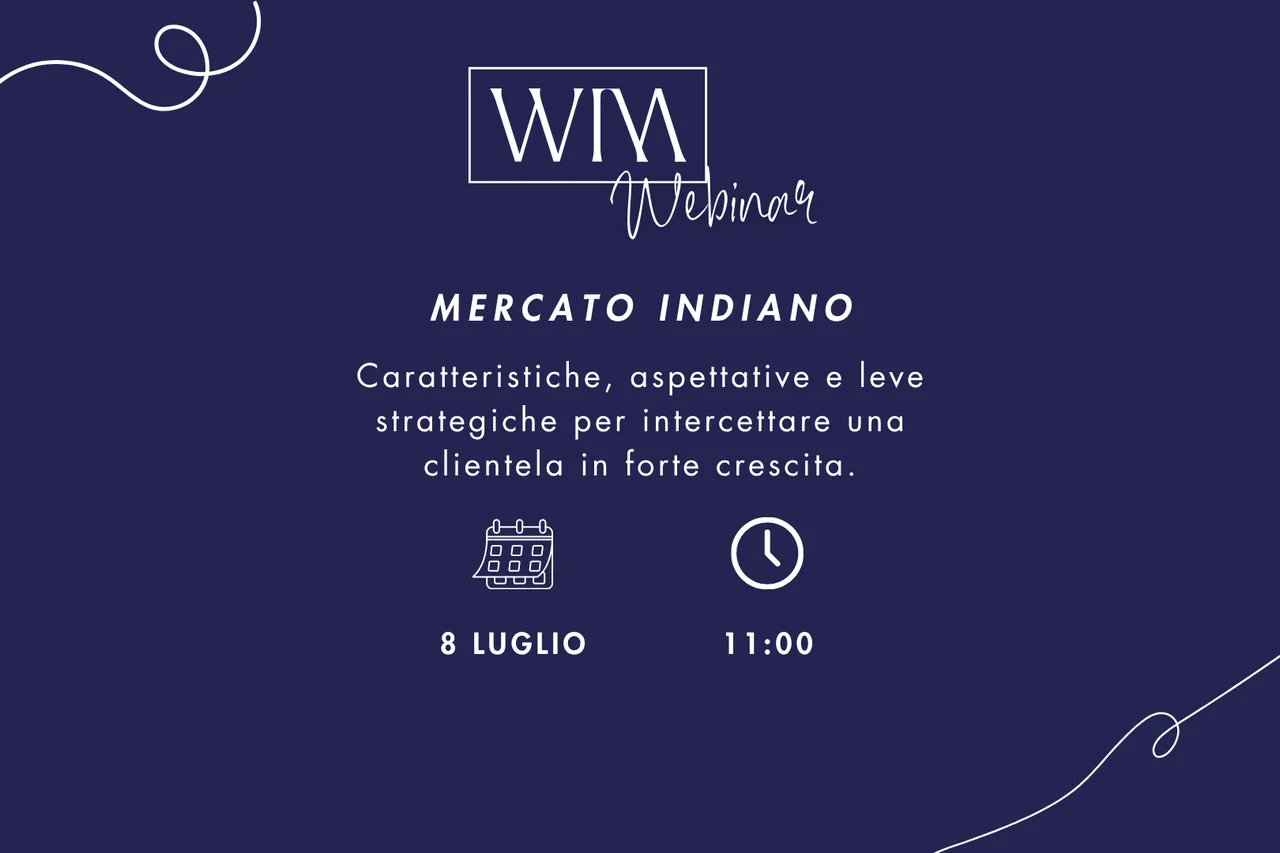
The Indian market is one of the biggest economic drivers of the global wedding industry, boasting 18 billion dollars in the destination wedding segment and a 15% annual growth rate. It is not a market you conquer with a promotional trip and a brochure. It is a market you conquer by changing your workflow, your positioning logic, and — to be blunt — the team you put on the field. Here are ten moves, one at a time. You can start most of them this Monday.
- Move the conversation to WhatsApp. Right away.
In the Indian market — just like in the Gulf — WhatsApp is not an optional channel; it is the primary workspace. Anyone who manages negotiations solely via email is perceived as slow and gets replaced. It is not bad faith: it is simply that the client is used to a different pace, featuring voice messages, photos, videos, and real-time updates. Upon first contact with an Indian lead, ask for their WhatsApp number and move the conversation there within the first 24 hours.
Action: Create a dedicated WhatsApp Business number for international clients equipped with a multilingual auto-responder, pre-approved templates for the most frequent replies, and an internal protocol that assigns management to a person available outside office hours.
- The first serious question is not about the budget. It is where they come from.
"Where they come from" does not mean geographically. It means culturally, religiously, and regionally. A Punjabi Sikh wedding and a Tamil Hindu wedding have almost nothing in common — the ceremony structure, the cuisine, the music, the schedules, and the rituals all change. Responding to two such different requests in the exact same way is the fastest mistake you can make.
Action: Add four fields to your lead form: family religion (Sikh / Hindu / Jain / Christian / Muslim / Other), parents' region of origin (Punjab / Gujarat / Tamil Nadu / Delhi / Other), the couple's current city of residence, and the approximate number of guests. These four fields will ensure you kick off with the right response.
- "It can't be done" is the answer that makes you lose the client. Every time.
The Indian market rewards those who find solutions. There are technical and regulatory limits that must be respected — a sacred fire inside a historical hall cannot be done, and that needs to be explained. But the first response must never be a flat refusal. "Let's see how we can do it" opens the conversation. "It can't be done" closes it, often permanently. An Indian client who hears a no loses trust and looks elsewhere.
Action: Take the ten most frequent requests you tend to refuse (a Mandap in a historical salon, a 6 AM start time, a buffet open for 6 hours, extra staff for the couple's outfit changes, multi-simultaneous setups, etc.) and write your possible alternative for each one — your "let's see how". Turn your team's "no's" into a playbook of solutions.
- Rebuild your quotes. A 3-day Indian wedding is not a 3-day American wedding.
The most visible — and expensive — mistake is sending a standard destination wedding quote to an Indian client. An American wedding over three days means 5+8+3 hours for a photographer. An Indian wedding in the same format means 14 hours a day. Every line item in your price list needs to be reviewed: staff, hours, extras, and ancillary services. If the quote does not reflect the true scale of the event, the client will realize it at first glance — and filter you out.
Action: Create a dedicated "Indian Destination Wedding" price list separate from the others, with line items rebuilt based on actual hourly commitments and resource demands. If you don't have one yet, take two weeks to design it alongside the team members who work on the ground.
- Map the decision-maker before you even work on the quote.
You are not working with a couple — you are working with a family. Often with multiple families together. The points of contact can include: the bride and groom, parents from both sides, siblings, an Indian planner, a family office, or a personal assistant. The person who approves the budget is not necessarily the one replying to messages. The person deciding on aesthetics is not necessarily the one deciding on timelines. Without this map, processes drag on for months over single choices.
Action: During the first alignment call with the client, ask explicitly: Who will make the final decision on the budget? Who validates the aesthetics and setups? Who coordinates with the bride's family? Who among you is the operational point of contact? Put names to each role. This is a question clients do not take offense to hearing — on the contrary, they appreciate it.
- Anticipate the visa issue. Well in advance and in a structured way.
Indian families send out invitations just a few months in advance. Schengen visas require embassy appointments that can only be booked well ahead of time. This combination can ruin events that are already set up — with deposits already paid. There have been deals closed this way: not because the event wouldn't work, but because too many guests failed to secure their visas in time.
Action: Prepare a "Schengen Visa" package to hand to the client upon contract signing: save-the-date templates to be sent at least 8 months prior, a standardized form to collect guest data, an official invitation letter template featuring the venue's stamp and letterhead, and a protocol with the venue for rapid bulk letter production. This is an administrative task that turns into a competitive differentiator.
- Build your package of specialized vendors. And document it.
No culture needs reassurance quite like Indian culture. Clients feel at peace if they know the vendor has already worked on Indian weddings — and knows the specialized supply chain. The good news: there is an Indian community in Italy that exceeds 200,000 people. Chefs, priests, henna artists, dhol players, choreographers, and specialized videographers. The supply chain exists. It just needs to be known and documented.
Action: Build a genuine vendor list dedicated to the Indian market: Indian caterers in Italy, chefs who can come on-site, priests available for ceremonies in Italy, henna artists, dhol players, decorators with Mandap experience, and specialized videographers. Put this list at the heart of your commercial pitch: prove to the client that you know exactly where to start operationally.
- Design your Instagram experience to speak to Indians.
In India, TikTok is banned — making Instagram the primary engine of inspiration for couples seeking a destination wedding. Well-curated reels of Indian weddings reach millions of views. An Italian Instagram profile looking to intercept Indian clientele must showcase Indian weddings, not just beautiful weddings. If you don't have Indian weddings in your portfolio yet, you can create one through a dedicated styled shoot — a strategy that has opened doors for several Italian businesses over the years.
Action: Schedule an Indian styled shoot next quarter in collaboration with other vendors in the Network (planners, caterers, decorators, artists, videographers). Shared cost, material usable by everyone, and an Instagram presence that begins signaling to the Indian market that you work in this space.
- Explain the cost of Italian labor. From the start, with transparency.
Indian families are used to labor costs that are far below European standards — while simultaneously expecting a high volume of staff dedicated to service during events. This combination creates asymmetrical expectations that, if not managed at the outset, generate recurring friction during the quoting phase. The leverage point is not lowering the price — it is providing a transparent explanation of the Italian regulatory and operational context.
Action: Prepare an "Italian Labor Cost" information sheet covering four to five essential points (cost of specialized staff, overtime, night shifts, Italian regulations, logistical costs) to deliver to the client alongside the quote. Not as a justification — but as information. It changes the dynamic of the negotiation.
- Publish. And publish with Indian planners in mind, not Italian magazines.
Being published is not a finish line. It is the beginning of a strategy. Feature publications in Indian outlets (WeddingSutra, South Asian Bride, Vogue India, KushMag) increase brand authority, trust, recognition, and above all, your selectability by Indian planners. In their selection process, planners check who has credible publications backing them up. You don't necessarily need to pay — you need a story to tell, top-tier editorial material, complete credits, and a selection of images ready for submission.
Action: On your next three weddings, request "submission-ready" material from the photographer from the get-go: 40-60 photos selected for publication (not 400), a two-paragraph narrative brief about the couple's story, and complete credits for all vendors. Build a submission pipeline targeting 2-3 Indian publications as a continuous activity, rather than a one-off initiative.
—
BONUS TRACK · The minimum budget nobody mentions
If a family approaches you with a budget of 300,000 euros for a three-day Indian wedding with 200 guests (events only, no hospitality), the quote they will receive from a serious vendor is: "It is not feasible to these standards." This is a phrase that must be spoken with honesty. The true floor for a well-executed event starts at 600,000-800,000 euros, and most high-level Indian weddings exceed one million. Squeezing the quote to fit an impossible budget won't save the negotiation — it will lose it during the execution phase when the expected level of production is not reached. It is better to explain the real costs upfront and let the family decide whether to adjust their budget or adjust their format.
BONUS TRACK · The diaspora does not ask for cultural discounts
The most widespread misconception is thinking that an Indian couple born in London or raised in New York is looking for a "more Western" wedding. It is the exact opposite. Quite often, the destination wedding is the opportunity to celebrate their cultural identity with even greater care, reinforcing traditions that find less expression in daily life. An Italian vendor who shows up with "Italian-style" proposals thinking they are intercepting the Indian diaspora is misreading the client. The diaspora wants tradition — delivered with Italian quality.
BONUS TRACK · The Tamil wedding is rare. And Punjabi is the majority.
A reality check that helps set communication priorities: the vast majority of Indian destination weddings in Italy come from Punjabi families (north, Sikh and Hindu, large and spectacular weddings, varied cuisine, festive atmosphere). Tamil weddings are statistically rare — Tamil culture tends to stay close to its community of origin. If you are building your presentation, your Instagram, or your styled shoots for the Indian market, start with the Punjabi aesthetic. It is the largest segment and the one that drives the volumes. The Gujaratis (more elegant, often vegetarian) are the second target worth investing attention into.
Continua a leggere...
Questo contenuto è riservato. Accedi alla nostra piattaforma per leggere l'articolo completo.
Prosegui su WIM for ProRead more...
This content is for members only. Log in to our platform to read the full article.
Proceed to WIM for ProCondividi questo articolo:

Diventa un
Digital Wimmer
Contenuti esclusivi, community e accesso anticipato agli eventi — tutto in un unico posto.





WIM For PRO · Where Ideas Meet
Sei già un
Digital Wimmer?
Community
Forum, directory e networking tra i professionisti del settore
Insights PLUS
Report esclusivi, WIM Survey e contenuti editoriali riservati
Priorità eventi
Accesso anticipato a tutte le tappe Tour, Talks e WIM Event
WIM For PRO · Where Ideas Meet
Are you already aDigital Wimmer?
Community
Forums, directories, and networking among industry professionals
Insights PLUS
Exclusive reports, WIM Surveys, and exclusive editorial content
Event priority
Early access to all Tour, Talks, and WIM Event sessions
Tutti i dettagli relativi ai vantaggi delle membership e al pricing dell’evento sono disponibili nel kit evento. Per qualsiasi necessità, assistenza o richiesta di approfondimento, puoi contattarci in qualsiasi momento scrivendo a info@wimforevents.com