
The marketing landscape for private events
Funnel, Messy Middle, WIM clusters, Cialdini's principles, generations: the five concepts that describe the audience, the market, and its decisions. If you want to do business, you can't keep…
Condividi questo articolo:
Funnel, Messy Middle, WIM clusters, Cialdini's principles, generations: the five concepts that describe the audience, the market, and its decisions.
If you want to do business, you can't keep everything in your head
This is the phrase with which we opened the first of our two marketing and communication webinars in 2026. It is not a slogan; it is a position of method. The vast majority of operators in the Italian Private Events Industry consist of micro-enterprises or sole proprietorships — a fact that clearly emerges from the WIM Insights Observatory — and this means a very practical thing: energy, attention, and resources are finite. They must be focused, not scattered.
From this premise comes this series of three articles, which constitutes the editorial translation of a broader professional training journey. Three articles that correspond to the three macro-areas of a sound marketing discipline: the Concepts that explain how the market works, the Tools to act upon it, and the Process to systematize both.
In this first article, we look at the landscape. Understanding how the audience behaves, which business models we belong to, which psychological levers influence purchasing decisions, and through which generational lenses to interpret all of this. It is the most abstract level of the series, but it is also the one that determines whether the tools and processes we apply in the next two articles will work or remain disconnected actions.
The entire journey, from concepts to tools to process, revolves around five questions that every company in our sector should be able to ask itself. Who really decides when choosing a wedding planner, a venue, a photographer? How does this audience gather information today? What mistakes do otherwise competent companies make that render them invisible to the market they want to reach? Who actually enters the decision-making process, and at what moment? And finally — how do you build an integrated communication strategy that holds all of this together?
To answer these questions, let's start with the conceptual model that has described consumer decision-making behavior for nearly a century: the funnel.
The funnel: three models, the same logic
The idea of the funnel is disarmingly simple. A funnel where a large number of potentially interested people enter at the wide top, and a few customers who actually purchase exit at the narrow bottom. The function of the funnel is to describe a potential customer's journey from the moment they discover you exist to the moment they make a purchasing decision.
Based on this logic, over a century of marketing literature has consolidated three versions of the same model. Knowing them all is useful because each focuses on a different aspect of the journey, and you will likely encounter all three when reading articles or listening to consultants.
The first version is called AIDA, an acronym for Attention, Interest, Desire, Action. It starts with attention — the potential buyer's initial awareness — and moves toward interest (relevant information), desire (the switch from "I like it" to "I want it"), and finally action (the actual conversion).
There is a distinction that few grasp on the first pass and that is worth making explicit: receiving many likes on a photo of your venue means social proof, not desire. The like is the interest phase. Desire is something more — it is the moment when someone moves from "I like this thing" to "I want this thing for my wedding." These are distinct phases, and confusing them leads to misinterpreting your marketing results.
The second version is called Awareness, Consideration, Conversion, Retention. The main difference compared to AIDA is the addition of the fourth phase: what happens after the purchase. In the world of private events, this phase is doubly crucial because it is divided into two moments. The first is obvious: from the signing of the contract to the event, there is a relationship-maintenance process. The second is less obvious, and that is the post-event phase — everything a satisfied customer can become for your brand: a review, a photo shoot, a video, word-of-mouth within their community. This relational asset is almost always underutilized.
The third version is the most operational, and it goes by TOFU-MOFU-BOFU: Top of the Funnel, Middle of the Funnel, Bottom of the Funnel. The top part of the funnel, where many leads have low purchasing intent; the middle part, where fewer people begin to seriously evaluate options; the bottom part, where a few leads are ready to decide. This is the preferred version for content creators because it helps tailor the right type of content for each stage: broad, introductory content at the top; specialized, comparative content in the middle; and decision-focused content — prices, testimonials, guarantees — at the bottom.
Three acronyms, the same logic. An alternative metaphor that we like, because it reflects the bidirectional nature of the process, is that of the megaphone: the company speaks forward to the widest possible audience, and that audience, once reached, responds by progressively narrowing down toward conversion. Not a passive funnel where gravity drags leads downward, but a cone where someone must make an effort to reach us. True customers are those who overcome that gravity.
The Messy Middle: reality is not linear
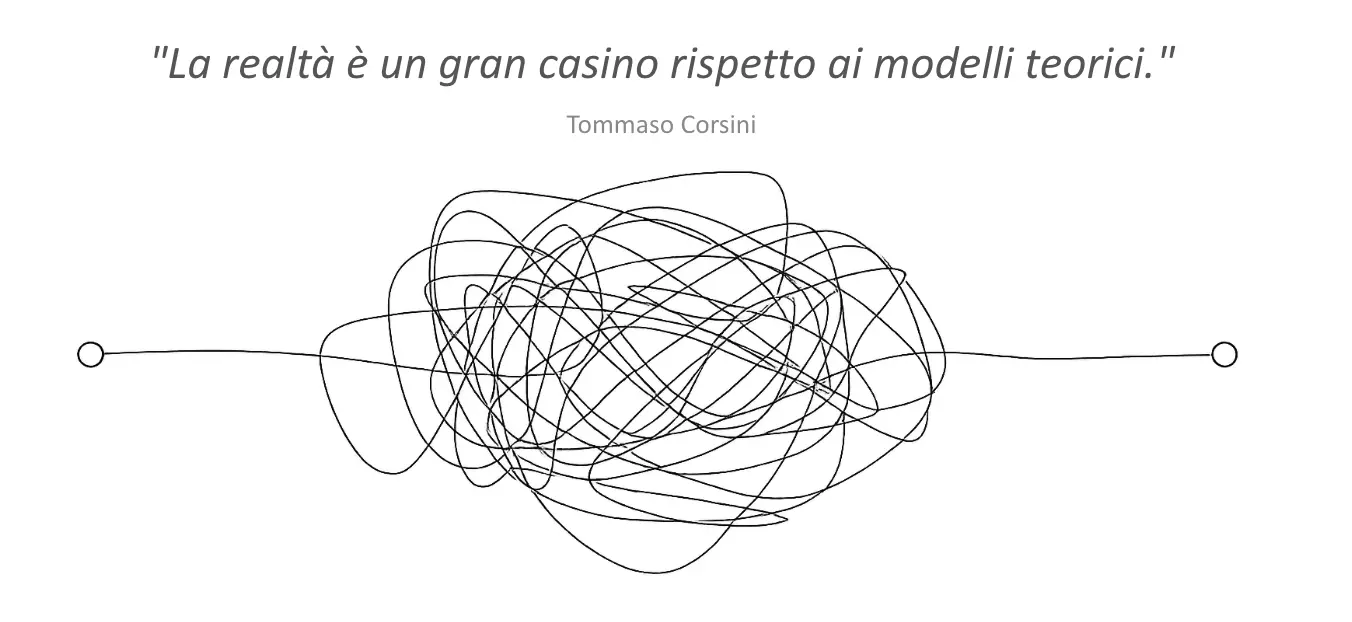
All very beautiful in theory. In reality, people do not behave in an orderly fashion. A bride does not serenely move from attention to interest to desire to action, passing through the phases in the sequence laid out by textbooks. A bride explores, evaluates, reconsiders, goes backward, exits the funnel, re-enters, changes her mind twice, and finally chooses. This is the daily reality of our sector, especially in weddings and any emotionally charged celebration.
Google formally recognized this in 2020 through research that named the phenomenon with a rather eloquent expression: the Messy Middle, the disordered center of the funnel. The study's conclusion is that the evaluation phase occurring between the initial exposure (the trigger) and the actual purchase is not linear but a rich branching of stimuli where exploration and evaluation chase each other in repeated cycles.
The practical consequence for marketers is important and must be stated clearly. The goal of a good communicator is not to dominate the customer's exploration and evaluation. You cannot afford to be present at every single touchpoint a couple will cross between their engagement and the signing of the contract — that would be a financial and organizational effort unsustainable for any company in the chain, and for the micro-enterprises in our sector, it is structurally impossible.
Instead, the goal is to get as close as possible to the trigger. Do not waste energy in the middle of the funnel, but intercept the stimulus that activates the decision-making journey as early as possible, thereby shortening the funnel itself. The closer to the trigger the customer meets you, the less exploration phase they will have to go through, and the higher the probability of conversion will be.
What does getting closer to the trigger mean concretely? It means being present — on the right channels, with the right content, at the right times — where and when a couple starts thinking about their wedding. It means being found at the earliest search stages, particularly regarding the destination and the venue, which are very often the first search terms for the international market. It means building a reputation that positions you naturally in the conversations preceding the conscious decision to organize the event.
There is no reason to be discouraged by discovering that reality is a mess compared to theoretical models. Models are useful. They serve to break down reasoning, address one problem at a time, and bring order to thoughts when reality is chaotic. The awareness that the audience moves in a disorderly fashion does not invalidate the models — it simply prevents us from applying them rigidly. They are used as a compass, not a road map.
The four WIM clusters: whom you are talking to
One of the things the funnel alone does not tell you is who the people, and the companies, traversing it actually are. For years, event marketing treated the market as an indistinct pool of "couples" or "industry companies," and paid dearly for this lack of distinction with communication campaigns that spoke to everyone and reached no one.
The WIM Insights Observatory, in collaboration with DISAG at the University of Siena, has worked in recent years on a market clustering using a k-means statistical analysis on a sample of over six hundred companies. The result is four clusters — four distinct business models that describe how one stands in the private events market. We have named them Luxury Artisan, Digital Enterprise, Reliable Professional, and Reactive Operator.
The Luxury Artisan has status, legacy, and the idea of an elite as positioning drivers. The value of the signature style. They typically work with High Net Worth clientele, international weddings, and destinations. Their promise is that of a unique, custom-made, confidential event — and confidentiality is a growing value proposition in a world where the publicizing of details becomes a nuisance for many affluent clients. They differentiate themselves through deep knowledge of territories, access to an exclusive network of vendors, discretion, and a commercial network built over decades.
The Digital Enterprise has scalability, innovation, and replicability as drivers. It is a more structured enterprise that must absorb larger demand flows to sustain itself, and therefore does not focus solely on the ultra-high end of the market. They often work in urban areas, where the frequency of work between corporate and private events is more constant throughout the year. Their promise consists of clear processes, curated content, and transparency — elements increasingly appreciated by Millennial and Gen Z clients. They differentiate themselves with high-level communication, product scalability, and codified quality standards.
The Reliable Professional has relationship, reputation, and consistency over time as drivers. They are often local businesses, deeply rooted in their geographic area, with a clientele that returns and brings new leads through word-of-mouth. Their promise is constant presence, experience, and the reassurance that things will go the right way.
The Reactive Operator has agility, opportunity, and fast response as drivers. It is often a freelance professional (partita IVA) or a small studio that works flexibly across a variety of requests, intercepts demand quickly, and is willing to build specific offers on the fly. Without the Reactive Operator — many photographers, the beauty world, hair stylists, make-up artists, and certain technical figures — the sector would lack its current production capacity. They are essential operators, not marginal ones.
There are two points worth emphasizing strongly, because a misunderstanding often emerges in conversations within the community.
First: the clusters are not product categories. A Luxury Artisan can be a planner, a caterer, a florist, or a photographer. The same applies to the other three clusters. There is no overlap between the category of service and the business model. It is about how you stand in the market, not what you sell.
Second: none of the four clusters is superior to the others. They are four different ways of standing in the private events market, each with its own competitive advantages and structural constraints. A single event normally involves professionals belonging to different clusters: a Luxury Artisan planner can work with a Reactive Operator for make-up and a Reliable Professional for catering. It is the system as a whole that produces the final celebration.
We delve deeper into each cluster in dedicated articles already available on Insights Plus, where you will also find specific strategic guidelines for each business model.
Cialdini's principles: what activates the "yes"
Once we understand how the audience moves (funnel + Messy Middle) and whom our work is aimed at (clusters), a fundamental question remains: what leads a person to say yes? What activates conversion at the decisive moment?
Robert Cialdini, an American social psychologist, published in 1984 what is effectively the reference text on the subject: Influence: The Psychology of Persuasion (with the highly significant subtitle: "How and why people say yes"). In 2016, with the book Pre-suasion, he added a seventh principle to the catalog. These are universal psychological levers — they are not specific to the event sector, they always apply, and Cialdini verified them experimentally in fields ranging from politics to commerce and law.
There are seven. For our profession, we point out three with particularly direct application — plus three others that must be briefly introduced because it would be a methodological error to overlook them, and finally the seventh from 2016.
Social proof. This is the principle by which people, in situations of uncertainty, do what they see others doing. In the private events market, it is a dominant lever. A bride entering a studio showing a scroll of photos she selected on social media to envision her wedding — design, entertainment, food and beverage — is practicing social proof: she is saying "I want to do what I see others doing." In the digital realm, every photo of an event published on Instagram generates a cascade effect on subsequent couples who want to replicate that same experience in that same venue. A single well-constructed image is involuntary marketing for the vendor: the couple photographing their wedding at a certain venue acts, effectively, as an unpaid sales agent for that venue. Curate the photography, curate the story, curate the memory left for others.
Authority. We give credit to those who are competent or recognized. A wedding planner featured in a landmark industry publication, awarded an international prize, or speaking at a specialized conference automatically acquires an authority that reflects on their commercial positioning. It is the natural driver for the Luxury Artisan, but it applies to anyone building positioning through authoritative visibility. Important: authority is built by the contexts in which you appear, not just by what you say. The cover of a glossy magazine and an invitation to speak at an academic conference perform the same psychological work, even though they pass through completely different channels. Another thing is also important: authority is not just a facade. In many cases, it is — fortunately — the result of years of proper work and earned reputation. The two align, and when they align, we can fully speak of trustworthiness.
Liking. We buy, often without realizing it, from people we like. This is an underestimated principle because it sounds too human to be effective as a marketing technique; yet Cialdini tested it experimentally on political candidates, professionals, and salespeople — in all contexts, the effect is significant. In our sector, it is probably the decisive lever of the first meeting. The customer chooses the vendor with whom they felt at ease during the first contact, often well before the negotiation enters economic details. Tone of voice, posture, quality of listening, capacity to let the interlocutor speak — Cialdini emphasizes that a likable person is above all someone who knows how to listen, not someone who knows how to talk — all of this is already marketing. The first meeting is not the sales phase preceding marketing; it is the marketing phase preceding sales.
Three other principles not to be overlooked. Reciprocity: we tend to return what we receive, and a free initial consultation of real value activates a commercial return (with common sense: reciprocity is not forced, it is offered). Consistency: we want to be aligned with the choices we have already made, which is why a brief signed at the beginning of the process is a sales tool, not just a working document. Scarcity — we will talk about this separately because in our sector it is not a technique, it is a structural condition.
And indeed, scarcity deserves a couple of extra lines. In traditional marketing, scarcity is almost always artificial: the offer "valid only for the next 48 hours," the "discount while stocks last," the "last three seats available" artfully engineered. In the private events marketing, scarcity is structural. A date exists only once — Saturday, June 15, 2027, has only one June 15, 2027. A prestigious venue has perhaps twelve good weekends a year. A top-tier photographer takes on twenty, maybe thirty weddings a year. Scarcity is not a lever to be built: it is a property of the market. This is probably one of the reasons why prices in our sector have grown significantly over the last twenty years: an increase in demand against a structurally limited supply inevitably produces price appreciation.
The final principle, added by Cialdini in 2016, is unity. The point here is not "this person is similar to us" — that is liking. Instead, it is "this person is one of us." Shared identities — family, group, community, common destiny — activate a persuasion much stronger than simple similarity. In a sector like ours, where the community of operators recognizes itself as an industry through events, training, and networks, unity is the lever with which to build the solidity of a brand within one's professional category over time. It is also one of the reasons why WIM exists as a project.
Generations as a marketing lens
Everything we have seen so far — funnel, Messy Middle, clusters, persuasion principles — should always be viewed through one final lens: the generational one. People born at different historical moments had different tools available during the formative phases of their digital lives, and these tools became preferred by them. Knowing which channels are preferred by which generation significantly changes the effectiveness of a campaign.
The dates come from standard Pew Research literature. Boomers, born between 1946 and 1964, prefer the media they came to know during their professional maturity: print, physical events, television, and email. They favor long-form content — articles, interviews, testimonials — and trust institutional references. For our market, they are often the decision-makers of the families paying for the events of the younger generations.
Generation X, born between 1965 and 1980, lived through the transition: the first computers, then the Internet, then social networks arriving in their adulthood. They prefer Google as a primary search engine, Facebook as a stabilized social space, and email as a relational channel. They prefer long articles, video documentaries, and reviews — they are the generation of informed quality-price comparison.
Millennials, born between 1981 and 1996, grew up with the Internet but became adults with Instagram (launched in 2010, bought by Facebook in 2012). Their preferred channel is social visual: Instagram for inspiration, Google for deep research, and LinkedIn for professional relations. They look for Reels, highly curated photography, and Stories. In the wedding and celebration market, they are the protagonists of commissioning today: they are between twenty-eight and forty-five years old.
Gen Z — sometimes also called Centennials — was born between 1997 and 2012. They are social-native: they do not remember a world without smartphones. Their preferred channels are TikTok, Instagram, and YouTube. They favor micro-videos, behind-the-scenes content, perceived authenticity, and speed. They are the generation now starting to enter the wedding market with their own direct commissioning, and for a few years, they have been the protagonists of other types of private events — birthdays, young corporate events, and milestone celebrations.
Gen Alpha, born from 2013 onward, is still pre-market for our sector. They should be observed, not yet targeted.
Two important clarifications to avoid mechanical interpretations of these generational clusters. First: the dates are indicative. A person born in 1995 is chronologically a Millennial but may display Gen Z digital behaviors, and vice versa. Second: the preference for a channel by one generation does not exclude that other contents work on that same generation. Google reviews, for example, hold value for Gen Z and Millennials as well, even if they are not their preferred content, because they activate social proof — and because AI engines like Gemini now pull directly from those reviews in user responses.
The generational lens is a calibration tool, not a classifier.
Toward the next article
What have we placed in the reader's hands with these five conceptual chapters? The structure of thought that precedes any effective communication intervention. We know how the audience behaves (funnel + Messy Middle), we know which segment of our market we are talking to (clusters), we know which psychological levers activate conversion (Cialdini), and we know through which generational lens to modulate the message.
What we do not have yet are the operational tools. Which content to produce, through which channels to distribute it, and how to decide if it is worth investing energy and budget in a specific communication action. This is the theme of the second article in this series.
Continua a leggere...
Questo contenuto è riservato. Accedi alla nostra piattaforma per leggere l'articolo completo.
Prosegui su WIM for ProRead more...
This content is for members only. Log in to our platform to read the full article.
Proceed to WIM for ProCondividi questo articolo:

Diventa un
Digital Wimmer
Contenuti esclusivi, community e accesso anticipato agli eventi — tutto in un unico posto.




WIM For PRO · Where Ideas Meet
Sei già un
Digital Wimmer?
Community
Forum, directory e networking tra i professionisti del settore
Insights PLUS
Report esclusivi, WIM Survey e contenuti editoriali riservati
Priorità eventi
Accesso anticipato a tutte le tappe Tour, Talks e WIM Event
WIM For PRO · Where Ideas Meet
Are you already aDigital Wimmer?
Community
Forums, directories, and networking among industry professionals
Insights PLUS
Exclusive reports, WIM Surveys, and exclusive editorial content
Event priority
Early access to all Tour, Talks, and WIM Event sessions
Tutti i dettagli relativi ai vantaggi delle membership e al pricing dell’evento sono disponibili nel kit evento. Per qualsiasi necessità, assistenza o richiesta di approfondimento, puoi contattarci in qualsiasi momento scrivendo a info@wimforevents.com