
From the Gulf to Italy: how to appeal to the Arab market (and why Dubai is a special case)
From the Gulf to Italy: how to appeal to the Arab market (and why Dubai is a special case)
Summary and in-depth analysis of the WIM Insights webinar with Samar Shawareb (Founder/CEO of Arabia Weddings), June 23, 2026. Second of six appointments dedicated to international markets for the…
Condividi questo articolo:
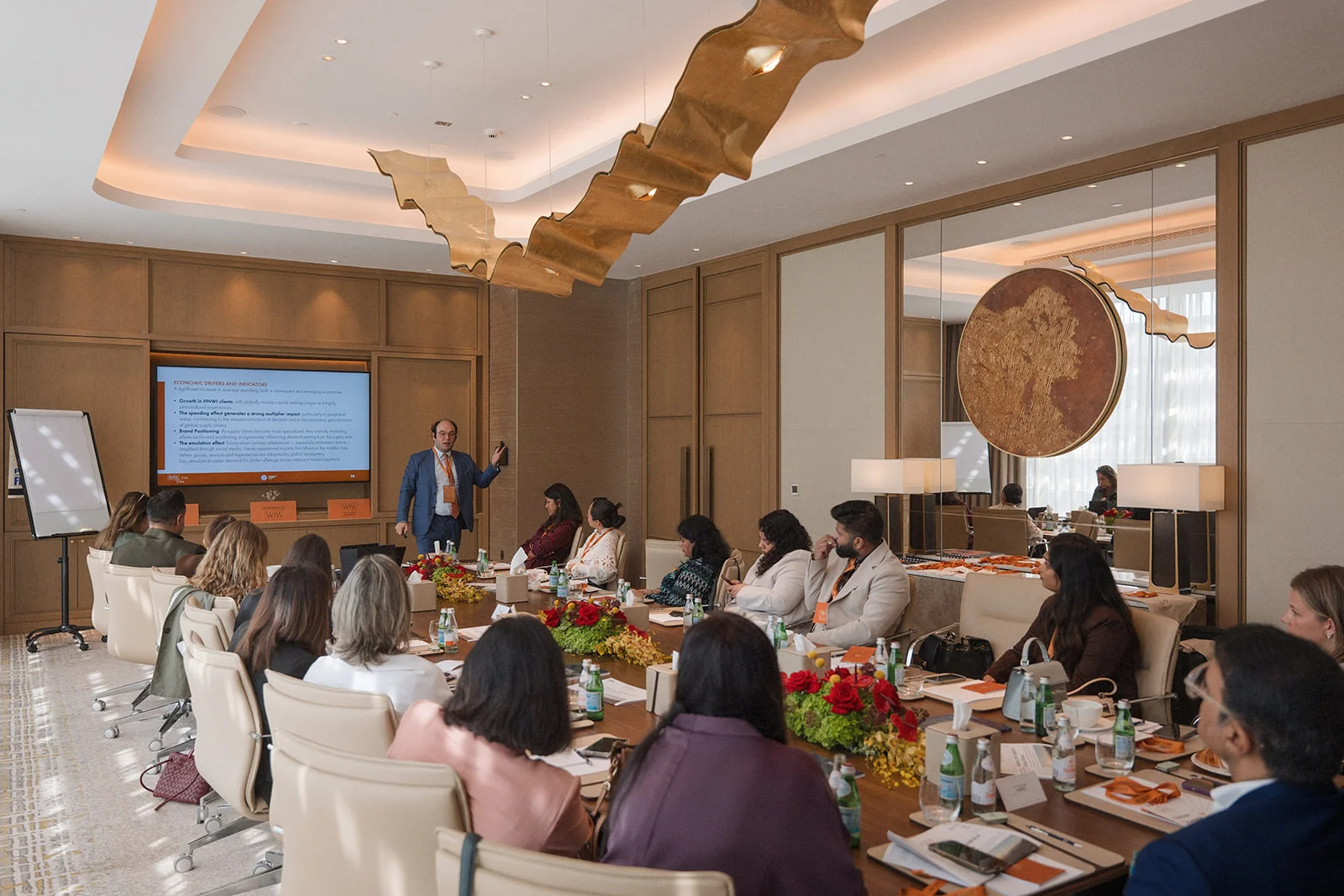
Summary and in-depth analysis of the WIM Insights webinar with Samar Shawareb (Founder/CEO of Arabia Weddings), June 23, 2026. Second of six appointments dedicated to international markets for the Italian Private Events Industry.
Where we are in the series
With this article, we enter the second of the six international markets of the WIM Insights 2026 program. The first one, dedicated to North America with Megan Garmers (The Wedding Masterclass), served as the opening of the practical series — you can find it, complete, in the same Insights Plus section. That webinar and its related article introduced a principle that applies to all markets: an international commercial presence is not built by translating your material, but by reconfiguring your workflow. It applies to Americans, it applies to Arabs from the Gulf, and we will see that it will also apply — with different nuances — to Indians, Russian-speakers, and Brits.
The three pillar marketing articles published in May — Concepts, Tools, Process — remain the theoretical framework upon which this entire series rests. When words like buyer persona, positioning, funnel, TIMER, gatekeeper, and Cialdini reappear in this article, it is because we are applying that framework to a specific cultural context. We will highlight it where relevant.
We start with what is, in terms of value per event, one of the highest markets absolute-wise for the Italian Private Events Industry: the Gulf Countries. Our guest is Samar Shawareb, founder and CEO of Arabia Weddings, who has been looking at the Arab wedding world from Jordan for two decades and manages the most authoritative B2B publication in the region. Six years of collaboration with WIM also give her a first-hand view of our market.
In this article, we address ten things in logical order: the geography of the market, why Dubai is a case apart, why Italy is attractive, the profile of the Gulf couple, the expected standard of service, the anatomy of an Arab wedding (with the Zaffe, traditions, and women-only weddings), rules on food and beverage, family dynamics and decision-making, what they expect from you, how they find you, and how to build visibility in that market.
Geography matters: GCC, Levant, MENA
First things first, let's focus on who we are talking about. Under the term "Arab world" lie different geographies and markets, with distinct economic and cultural dynamics.
The GCC — Gulf Cooperation Council — is the political and economic union of six Gulf countries: Saudi Arabia, the United Arab Emirates, Qatar, Kuwait, Bahrain, and Oman. It is the economic heart of the region, the area with the highest per capita income, and the main pool of the luxury clientele that interests us.
MENA — Middle East and North Africa — is the wider region, which in addition to the GCC includes the Levant countries (Jordan, Lebanon, Iraq, Palestine, Syria) and North African countries (Egypt, Tunisia, Morocco, Algeria, Libya).
For our market, the primary focus is on GCC + MENA. This is where the vast majority of Arab couples who choose Italy as a wedding destination come from. It is useful to know this because speaking to a client from the Gulf is not the same as speaking to a client from Beirut: they share many cultural and religious elements, but they have different service expectations, celebration formats, and family dynamics.
An important premise to avoid building lazy stereotypes: the Arab world as a whole remains largely traditional, with weddings celebrated in their cities of origin, sometimes in a women-only format in more conservative contexts. What we are talking about in this article is instead the growing, dynamic, high-budget segment of modern, young, globally educated Arab couples who choose to get married abroad. They do not represent the statistical majority of the Arab wedding market. They represent almost the entirety of the Arab wedding market that arrives in Italy.
Why Dubai is a case apart
Dubai deserves a dedicated section because treating it as "the largest city in the Gulf" and applying the same logic as the rest of the GCC is one of the most frequent mistakes we see in our sector.
Dubai is a melting pot. The resident population is composed in its vast majority of expats: Indians, Pakistanis, Filipinos, Brits, Lebanese, South Africans, South Americans, Italians, French. Only a minority consists of Emirati citizens. The couples who get married in Dubai — or who select an international destination — are predominantly multicultural, often mixed couples, looking for a global aesthetic rather than a traditional Arab aesthetic.
Commercial consequence: the person writing to you from Dubai might not be Arab at all. It could be an Indian couple who has lived there for ten years, a French-Lebanese couple, a British expat couple, or a Singaporean-Brazilian couple. Treating the request as an "Arab wedding" risks starting off on the wrong foot. The first inquiry to make, gently, concerns the couple's cultural background and desired aesthetic.
Thanks to the multiculturalism of these couples and the fact that they often seek "neutral" destinations compared to their cultures of origin, they represent an interesting market for our promotion in the long run. This is also because they often enjoy income and tax situations that are notoriously very favorable in the emirate and, consequently, have a very high spending capacity. Therefore, Dubai remains extremely important as a logistical hub — it is from there that many destination weddings in the GCC are organized, and it is there that many of the reference planners are based — but it is not the only destination for targeted promotion aimed at Arab couples in the luxury segment.
The cities to focus on are Riyadh, Jeddah, Doha, Kuwait City, Manama, and Muscat. That is where the traditional Arab clientele we are interested in lives. Dubai remains the professional hub, not the primary pool.
Why Italy attracts
Couples from the GCC who choose an international wedding destination essentially consider four regional alternatives — Greece, Cyprus, Turkey, and at a greater distance, Spain and Portugal — and Italy. Knowing our real competitors is useful to understand where the decision is truly made.
Greece is geographically close to the Gulf (a significant logistical advantage for guests and family), offers highly scenic backdrops suitable for high-end weddings, and has a mature tourism industry. Turkey has a structural competitive advantage for Gulf clients: no entry visa requirements. For guests arriving from dozens of different countries, the absence of a visa is worth more than we can imagine. Cyprus and Portugal are emerging markets, growing but less structured.
Italy competes on a very specific mix of levers. Accessibility from the main Gulf hubs is excellent — Emirates, Qatar Airways, Etihad, and Saudia have multiple daily frequencies to Milan, Rome, Bologna, and Venice. The scenery is uniquely varied: alpine lakes, Tuscan hills, the Amalfi Coast, Puglia, Veneto, Sicily. Italian cuisine is the global benchmark for fine dining and banqueting. The historical heritage — villas, palaces, historic residences — is simply unparalleled in any of the competing destinations.
And then there is a less talked about but very important lever: perceived prestige. Getting married in Italy, for a Gulf couple, has a status value that competing destinations do not match. Status is not a minor variable in high-end weddings coming from this region. It is often a primary variable. Italy is one of the few places in the world where getting married "is worth it" beyond the single event.
The profile of the destination Arab couple
Who are the couples organizing an Arab destination wedding in Italy? Three main characteristics. They are young — often Millennials or Gen Z. They have studied abroad, speak at least two languages (English almost always, sometimes French), and are technologically very advanced. They are modern in form — making choices in style, aesthetics, and entertainment that distinguish them from the traditional weddings of their parents and grandparents — but deeply respectful of traditions in substance.
This is a point worth pausing on, because it contains a nuance that lends itself to misunderstandings. The modern Arab couple chooses a destination wedding precisely to break with tradition: they seek a different format, want a freer experience, and want to bring their international friends to a destination that makes them feel comfortable. At the same time, certain traditional elements remain non-negotiable: the Zaffe (which we will look at later), family dynamics, respect for elders, and certain dietary rules. Understanding where they can break and where they do not want to break is the key sensitivity for the vendor working with this market.
They are also very demanding clients in terms of service. It is worth sharing the anecdote about Tommaso that emerged during the webinar: anyone landing in business or first class on Emirates in Dubai finds, upon exiting the airport, a pre-assigned driver service that — across hundreds of flights a day, thousands of business clients — assigns its driver to each passenger in less than a minute. These are hundreds of contemporary cars, sorted flawlessly. It is a level of service efficiency hard to match in Western contexts.
Why do we mention this? Because anyone coming from the GCC brings this expectation of standards with them. They do not expect the exact same level to be reproduced elsewhere — they know that service outside their country is different. But they expect that whoever serves them knows, at least, what benchmark they are coming from. Knowing the client's starting point is the basis for building a credible proposal. Without this cultural awareness of service, you are speaking into a void.
Communication: WhatsApp, speed, and never a first negative response
Regarding operational communication with Gulf clients, three rules impose themselves as deal breakers.
The first: WhatsApp is the primary channel of communication, not email. Research conducted by Arabia Weddings showed that 85% of GCC couples, when asked how they prefer to receive the first proposal from an Italian vendor, answer "via WhatsApp". And we are talking about personal WhatsApp, not WhatsApp Business, because the distinction for the Gulf client is less sharp. This means that the first point of commercial contact, for a large portion of Arab leads, will happen via direct message. You need to be ready: have a team that manages WhatsApp with the same professionalism as email, presentable material to send via WhatsApp, and the ability to respond with the same formal care expected of an email.
The second: response speed. Even more so than in the North American market (where we talked about 24-48 hours), for the Gulf market, the expectation is even more stringent. The Arab client expects a quick reply even on weekends, in the evening, and sometimes even at night. They live in contexts where services always respond. If you don't reply within a day, the couple moves on to the next destination — not to the next vendor, to the next destination. Obviously, we cannot and should not replicate a 24/7 style, but we can actively manage the expectation: a welcome note, a clear availability calendar, and a person who monitors the channel and always responds with a first acknowledgment within 4-6 working hours.
The third: "no" is not an acceptable first response. Even when faced with seemingly impossible requests — fireworks in the historic center, capacity exceeding the license, acoustic waivers — the first answer is never "it cannot be done." It is "I will check," "I will let you know," "let me understand how." Even if the final result is a reasoned no, the way of getting there radically changes the perception of the negotiation. It is a point of commercial style worth absorbing: it is called professional flexibility, and for the Gulf market, it is one of the conditions of entry.
Anatomy of an Arab destination wedding
Let's look at the operational heart: how an Arab luxury destination wedding in Italy is concretely structured.
Number of guests and duration
The average is about 200 guests per destination wedding. The range is wide: from 150 to 600 guests, with extraordinary cases reaching up to 800. The standard duration is three days — pre-wedding event, wedding day, farewell brunch (or pool/beach party). This is similar to North American expectations, with two important differences: the concentration on three days is more rigid (the seven-day long American weeks are less frequent) and the guests pay for their own travel and accommodation (with the important exception of Indian weddings, where the family often pays for everyone — a distinction worth keeping in mind).
The practical consequence of this difference is that the Arab couple feels they must "compensate" for the guests' financial effort with an extraordinarily high level of hospitality throughout the event: luxury accommodation, flawless transfers, superior gastronomic experiences, and side activities. It is a market that rewards excess care; it does not merely tolerate it.
The pre-wedding evening: the Italian night
The first day is almost always dedicated to welcoming guests. It is the ideal moment to introduce an Italian theme into the event: regional cuisine, Italian music (an opera singer for fifteen minutes is almost always appreciated, it carries cultural value), and recognizably Italian decor. The couple brings their guests to Italy also to give them the experience of Italy: using the first day for this is a smart choice for both programming and storytelling.
The wedding day
Almost always, the official wedding (civil or religious) is celebrated before arriving in Italy, in the country of origin. In Italy, a symbolic ceremony takes place — not legally binding but highly deeply felt. A small minority of Christian couples (especially Lebanese, but also Jordanian, Iraqi, and Palestinian) instead request a church ceremony with a dedicated priest, and in those cases, all ecclesiastical procedures must be managed.
The typical flow of the day: symbolic ceremony (sometimes omitted); cocktail reception; grand entrances of the groom and the bride (which we will talk about next); gala dinner; cake cutting; after party. For each moment, a dedicated space is necessary, and for each space, a backup Plan B for bad weather is required: in Arab weddings, bad weather is not a remote hypothesis but a variable to contemplate with care, especially given the production level they generally expect.
The Zaffe
It is one of the most traditional and beloved elements of an Arab wedding, and for many couples, it is non-negotiable. It is a troupe of musicians — typically percussionists, sometimes accompanied by a melodic instrumentalist — that accompanies the groom's entrance into the wedding area. Right after the cocktail hour, while the guests are already seated or entering, the groom arrives accompanied by his male friends and the rhythm of the Zaffe, chanting ritual formulas. The procession stops on the dance floor. Next, the bride enters with her father — softer, sometimes classical music — up to the dance floor, where the father hands her over to the groom. At that exact moment, the music explodes and the collective dancing begins.
The Zaffe typically lasts no more than 25-35 minutes. Specialized troupes exist in Italy (particularly in Milan, Rome, and some tourist cities), in Germany, and in other parts of Europe. For the Italian vendor, it is important to already have the contacts of available troupes in their database, because finding them at the last minute is impossible and availability in high season is limited. Often, couples also bring their own DJ — a trusted Arab DJ who knows the specific repertoire. The DJ must be welcomed, hosted, and integrated into the local technical team: not replaced or opposed. Alternatively, you can try to find DJs specialized in Arab music in Italy; in this case, it is important to put them in touch with the couple before the wedding.
Food and beverage
Abundance and variety are the key words. You don't evaluate the quantity of a single course as much as the variety of the buffet. This is different from the Italian approach, where if a dish is proposed, there must be enough for all guests; in the Arab format, standing out for variety is more important than dimensioning each course.
Dietary rules require attention. Never serve pork to Arab guests without explicit notification: for the luxury segment, as a rule, it is avoided altogether. If the couple wishes to include cured meats or cold cuts in the pre-wedding Italian night buffet, they must be presented on separate plates, on separate tables, with clear labeling. This is a detail of respect that is not negotiated.
Halal is a different category. It does not just mean "pork-free." Halal refers to the way the animal is slaughtered according to Islamic law. It is a more specific request that many Italian caterers cannot satisfy without relying on a specialized supplier of certified Halal meats. When a couple requests Halal, you must understand exactly what they mean: some more modern couples accept informal substitutions, while others require formal certification. Always verify beforehand.
The beverages
The management of alcohol must be coordinated with the couple. Options range from a full open bar (for more liberal couples and family groups) to a mixed setup (an alcoholic bar and a parallel mocktail bar, with discrete service of the alcoholic part for more conservative relatives) to a completely alcohol-free wedding. In all cases, a high-level mocktail bar — with Aperol Spritz, Mojito, and Gin Tonic recreated without alcohol using the same aesthetics and refinement as the original cocktails — is now a standard of service for the Gulf market, no longer an exception. Arab Gen Z is drinking less and less, exactly like the Gen Z of all the other countries we saw in the North American webinar.
Family and decision making
The older guests in the family hold a higher significance compared to what we experience in Italian custom. Even when the couple decides to forgo a seating chart for young people — opting for "free zones" — seats for grandparents, elderly aunts and uncles, and high-ranking family figures must always be explicitly and carefully allocated: away from the speakers, in dignified positions, with dedicated service. It is a rule of respect that should not be underestimated, because it directly affects the overall perception of service quality by the family paying for the event.
On decision-making, there is a practical point worth clarifying that echoes the third article of the marketing series (the Process): in Arab culture — and generally in many Middle Eastern and Asian cultures — the decision-maker is not always the couple. Often it is the bride's mother or the groom's father. Frequently, a mediating family figure intervenes (an influential uncle, an older sister). Understanding who really decides and directing communication to that person — while formally keeping the couple as the main interlocutor — is a key commercial sensitivity that saves a lot of time and avoids misunderstandings.
The case of women-only weddings
A short parenthesis on a format that some of you might encounter. Women-only weddings are typical of more traditional Saudi culture and certain segments of the conservative Gulf. In these weddings, the female celebration is the main event: rich, highly decorated, animated with music and dancing. The separate male celebration is more sober. Sometimes a couple wishes to celebrate a second, exclusively female wedding in Italy, after having already celebrated a traditional wedding in their country of origin.
Operational requests for a women-only wedding are very specific. The event area must be completely separate and visually isolated: no man can cross it, and no one can see into it — not even from a hotel window overlooking the area. The service staff must be entirely female: waiters, photographers, videographers, and musicians. Male bands, if requested, play in a separate room and are projected on screens inside the event area. The same goes for male singers. The logistics are demanding but feasible, especially in large locations with dedicated facilities.
What they expect from you: the operational package
Lining up what the GCC market concretely expects from Italian vendors:
Strategic venue selection. Arab couples prefer spaces that have two characteristics: aesthetic grandeur (large scale, scenic effect, clear historical identity) and absolute privacy (no overlooking, no adjacent public access areas). It is not the same aesthetic sought by an American couple, who often prefer cozy intimacy. For the Arab client, the size of the space is part of communicating the value of the event. A smaller, more intimate villa might be perceived as "below standard," everything else being equal.
End-to-end logistics coordination. Airport transfers with premium vehicles, well-managed hotel allotments, experiential activities for pre and post-wedding, eventual side trips, and coordination with expert DMCs. On this point, we made an important operational observation during the webinar: working with DMCs that are part of the Virtuoso network gives access to premium hotel and airline amenities that make a difference in the perceived level of service offered to guests. In general, it is important to handle travel and hotel matters with hospitality and travel professionals to guarantee the necessary operational standard for the client and their guests.
Specialized technical services. Hair and make-up artists with specific experience in the type of look requested by Arab clients (a "natural" look for a Lebanese bride is not the same "natural" look for an Italian bride — it is a sensitivity to build), high-level photography with multiple teams, videography, and sometimes drones and fireworks.
Fluent English throughout the entire team involved in the client relationship. It is not enough for just the planner to speak English: it needs to be spoken by whoever manages the contracts, handles administrative procedures, and does the day-of coordination.
Transparency and cultural alignment
Two points that close the webinar and are worth fixing with care.
The first: absolute transparency on professional roles. It is a frequent misunderstanding: the Arab couple does not easily distinguish between a wedding planner, wedding designer, wedding coordinator, and event manager. These are roles that have a clearer definition in the American and British worlds, are often used interchangeably in the Italian world, and do not exist at all as distinctions in the Arab world. Heavy misunderstandings arise from this: the couple hires someone they thought was an end-to-end planner, only to discover later they were a designer (who only does the aesthetic direction and not the operational coordination). Consequence: describing your role with explicit clarity in commercial materials and contracts is a condition for commercial survival.
The second: no hidden costs. It applies to North America, it applies to the GCC, it applies to every international market. An exact description of how the price is composed, a declaration of what is included and what is not, transparency on VAT, deposits, and cancellation penalties. This is the highest point of return on invested time: five hours spent building a transparent and well-made proposal template save two hundred hours of renegotiations and rebuilding trust.
How they find you: the role of directories and LLMs
This is probably the newest and least obvious insight from the webinar. For the Gulf market, the primary discovery channel is not Instagram. It is not Pinterest. It is not even your website alone.
It is directories. For two reasons.
The first is structural. A Gulf couple looking for an Italian vendor typically starts from a recommendation (planner, friend, reference agency) and then goes to verify on an industry directory. On Arabia Weddings, on The Knot, on other international B2C publications, and recently also on WIMforPRO. Directories are the intermediate point of trust between the referral and the first direct contact.
The second is AI-driven, and it is the real paradigm shift. More and more couples are using ChatGPT, Gemini, Perplexity, and other LLMs for vendor pre-research. LLMs, by the nature of how they function, tend to cite structured sources — directories with standardized fields regarding location, language, years of experience, and event type — much more than individual corporate websites. A directory is readable in a structured way; a website, no matter how beautiful, is less easily parseable. The practical result: in the first pages of LLM responses to prompts like "top destination wedding planners in Italy for Arab couples," the vendors present on Arabia Weddings, leading industry directories, and WIMforPRO emerge. Those who are not there are quite literally not found by the tools that now handle a growing share of pre-searches.
It is a low-cost, high-yield commercial investment: being present, with a complete and updated profile, on the directories that carry weight for the market you want to serve.
Alongside this, two traditional channels remain central. The first: international B2B events, where Gulf wedding planners look for their Italian partners. Samar will come to Italy in November with a selected group of GCC and MENA planners to the WIM Event in Florence, and WIM is organizing a dedicated appointment with Arabia Weddings in Dubai in January 2027. Being there, physically, is probably the highest-yielding commercial investment for anyone wanting to enter this market seriously. The second: the publication of already realized Arab weddings. Showing specific experience — case studies, images, videos, testimonials — is an accelerator of credibility in the market. Do not hide the Arab weddings you have done: publish them, show them, talk about them.
The underlying principle
Towards the end of the webinar, Samar condensed the message into three words: cultural alignment, communication, transparency. Cultural alignment, communication, transparency. These are three levers that, applied together, build the trust that leads to the contract, and from the contract to word-of-mouth.
Cultural alignment does not mean becoming an expert in Arab culture. It means showing that you are trying: knowing the basics (Zaffe, family decision-making, dietary rules), asking the right questions at the first contact, and showing in your commercial materials that you understand the difference between a couple from Riyadh and a couple from Beirut.
Communication means fluency in English, a presence on WhatsApp, speed of response, never a "no" as a first reaction, and always an "I will check, I will let you know."
Transparency means clarity on roles, clarity on prices, clarity on expectations, and clarity on cancellations. No hidden costs. No ambiguity of scope.
Three levers, applied together. On their own, each is a half step. Together, they are a market.
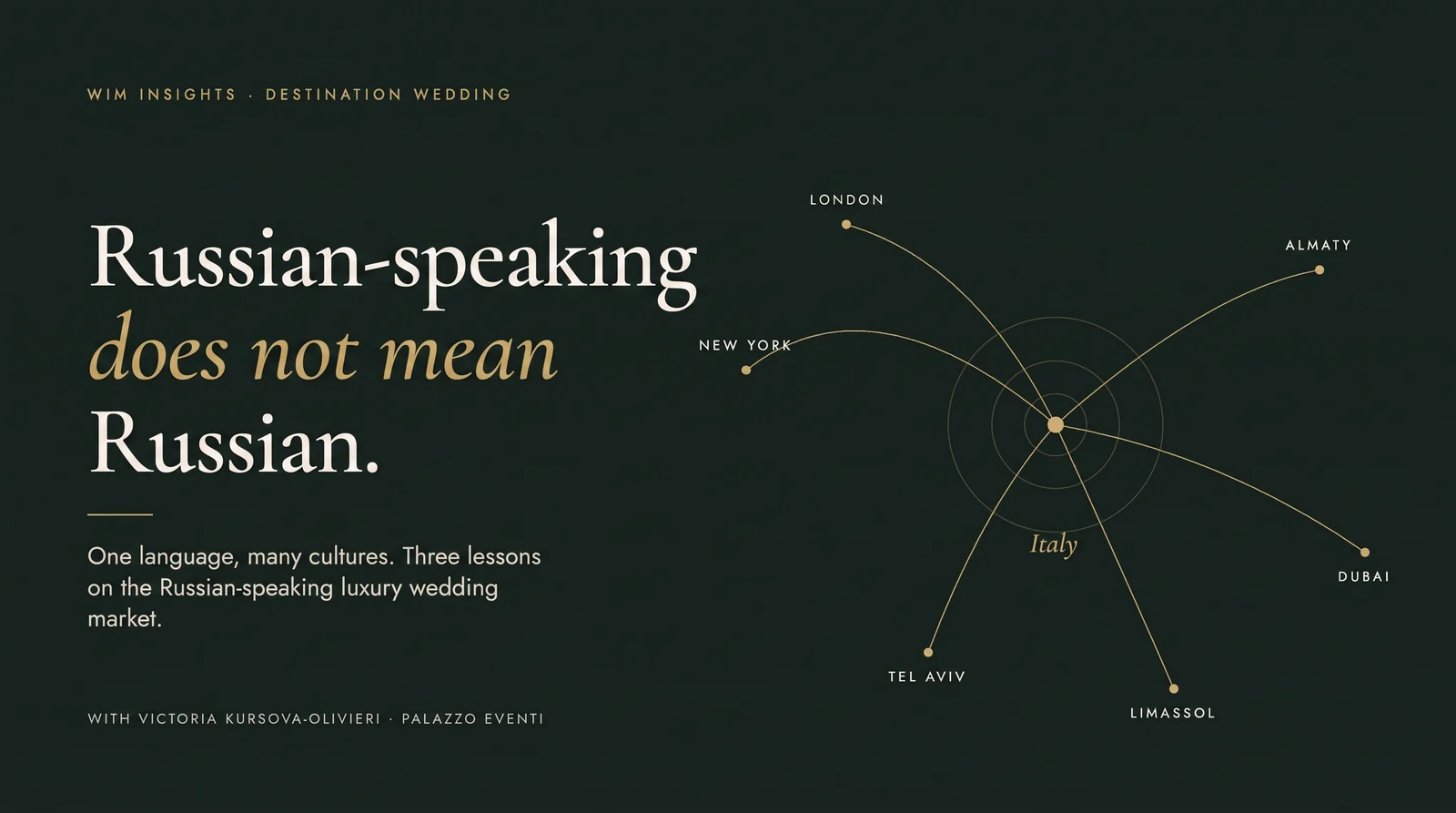
The next appointment in the international series is Wednesday, July 8, dedicated to the Indian market. The following one, Tuesday, July 21, to the Russian-speaking area. The logic is what you are seeing article after article: each market has its own cultural, operational, and commercial specificities, but the reading framework — that of the three marketing pillars published in May — remains the same. The content of the proposal changes, not the structure of the process.
Now we know how to speak to the Gulf. It's up to you to do it.
Continua a leggere...
Questo contenuto è riservato. Accedi alla nostra piattaforma per leggere l'articolo completo.
Prosegui su WIM for ProRead more...
This content is for members only. Log in to our platform to read the full article.
Proceed to WIM for ProCondividi questo articolo:
Diventa un
Digital Wimmer
Contenuti esclusivi, community e accesso anticipato agli eventi — tutto in un unico posto.













WIM For PRO · Where Ideas Meet
Sei già un
Digital Wimmer?
Community
Forum, directory e networking tra i professionisti del settore
Insights PLUS
Report esclusivi, WIM Survey e contenuti editoriali riservati
Priorità eventi
Accesso anticipato a tutte le tappe Tour, Talks e WIM Event
WIM For PRO · Where Ideas Meet
Are you already aDigital Wimmer?
Community
Forums, directories, and networking among industry professionals
Insights PLUS
Exclusive reports, WIM Surveys, and exclusive editorial content
Event priority
Early access to all Tour, Talks, and WIM Event sessions
Tutti i dettagli relativi ai vantaggi delle membership e al pricing dell’evento sono disponibili nel kit evento. Per qualsiasi necessità, assistenza o richiesta di approfondimento, puoi contattarci in qualsiasi momento scrivendo a info@wimforevents.com