
The North American market: what American couples are really looking for
Summary and deep dive of the WIM Insights webinar with Megan Garmers (The Wedding Masterclass), June 9, 2026. The first of six appointments dedicated to international markets for the Italian Private…
Condividi questo articolo:
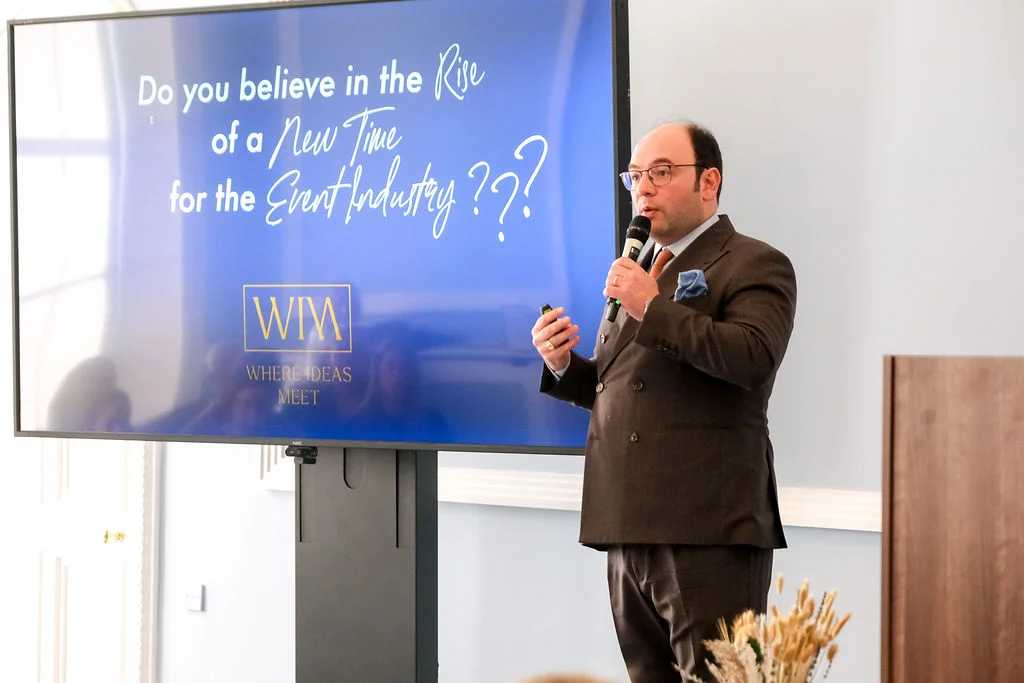
Summary and deep dive of the WIM Insights webinar with Megan Garmers (The Wedding Masterclass), June 9, 2026. The first of six appointments dedicated to international markets for the Italian Private Events Industry.
From Theory to Practice
In the two marketing webinars in May, we worked on the theory of marketing and communication within our profession. The first article in the Insights Plus series dedicated to Marketing focused on Concepts, highlighting how the market behaves: the three versions of the funnel, Google’s Messy Middle, the four WIM clusters, Cialdini’s principles, and the generational lens. The second article was dedicated to Tools, providing operational levers: content, channels, the TIMER filter, and the 80/20 rule. The third focused on Process, aligning all of this within a corporate discipline: positioning, clients, GAP, KPIs, and operations.
That was the conceptual map. Now, we begin to translate it, market by market.
We start with the most important destination wedding market for Italy in terms of volume and generated value: North America. Together, the United States and Canada produce volumes and turnovers that single-handedly sustain a major portion of our industry’s premium incoming business. We conducted this analysis with Megan Garmers of The Wedding Masterclass, who brings a solid research foundation to the table: over 3,000 North American professionals surveyed since the beginning of 2026, around sixty B2B educational events per year across the USA, Canada, and beyond, and a first-hand perspective on how the final decision-maker — the couple — and the professional influencer — the American planner — operate.
In this article, we look at eight key areas in logical order: the state of the market, what couples look for, why some vendors are not chosen, where couples search for vendors, cultural-operational differences, what they are actually buying, how to build business relationships with gatekeepers, and six concrete actions to start implementing this very week.
The State of the North American Wedding Market: Four Trends
Four trends currently define the American wedding market, particularly for destination weddings. Understanding them is fundamental to avoid pitching to the wrong client.
The first: destination weddings are growing, but in a way that is worth understanding properly. We aren’t just talking about volume. We are talking about the fact that American couples today consider multiple different locations and services for the various moments of their engagement and wedding experience. The practical consequence is significant for our supply chain: even if you aren’t hired for the entire wedding, you can intercept individual components — the welcome event, a farewell brunch, an experiential farm-stay, or a themed activation. The “take the whole wedding or take nothing” dichotomy no longer exists. A wedding is an ecosystem of events spread over multiple days and sometimes multiple locations, extending even to “multi-destination” events.
The second: budget patterns are shifting. For years, the marketing of American events was defined by guest count — how many people you invite versus how much you spend. Today, that is no longer the case. Couples are cutting back on guest counts while maintaining or increasing their overall budget, shifting investment from quantity to the quality of the experience. They want intentionally selected guests, curated experiences, and personal storytelling. A wedding with 40 guests can be worth as much as a wedding with 200 — sometimes even more.
The third: luxury positioning wins. But with a critical caveat. The definition of luxury is not “how much it costs” — it’s “how it makes you feel.” An authentic, beautifully narrated venue with meticulous attention to detail, which succeeds in giving the couple and their guests a memorable experience, can be perceived as luxury without being the most expensive on the market. This applies to venues, planners, makeup artists, and every link in the chain. Positioning yourself as luxury means speaking to memorability, not price lists. This point is worth reiterating because it is prone to misunderstanding: this does not mean that American couples traveling for a destination wedding will spend blindly just because they can. It means they select carefully and will reward those who know how to pitch and execute their proposal as an experience, rather than a standardized service.
The fourth: multi-day celebrations are now the norm. Three days is the bare minimum. A welcome event on day one, rehearsal and social activities on day two, ceremony and reception on day three, and a farewell brunch or closing activities on day four. For destination weddings, the calendar easily extends to five, six, or seven days filled with experiential activities and cultural side trips. The product being sold is no longer the wedding day — it is a week of orchestrated celebration. In this entire context, the tourism and travel component is increasingly fundamental. Because of this, especially for planners, it is essential to establish strategic partnerships with reliable travel agents. (See the articles regarding the Travel Industry webinar produced in collaboration with Dreams Team).
What American Couples Are Really Looking For
Six characteristics define this demand. It is useful to lay them out because they are not mere opinions: they are the results of research conducted on over 3,000 US professionals who live and breathe that market daily.
Authenticity. Couples want real, unpolished experiences. They want genuine culture, not a tourist performance. There is a delicate point here: sometimes American clients arrive with a preconceived idea of what “Italy” is — pizza, pasta, mandolin — which is a stereotype. Our job as vendors is neither to indulge the stereotype nor to attack it: it is to guide the client toward the authenticity of the local region where the wedding takes place, showing them, without forcing it, what the true cultural offering of that specific destination is. It’s a process of guidance, not imposition. In this sense, it is also crucial to understand and know your client’s cultural background in order to guide them within a context they can comprehend and appreciate, without overwhelming or scaring them away by forcing a deep dive into the entire cultural scope of a destination.
Emotional Connection. Couples want moments they will talk about for years, not events that are technically perfect but emotionally flat. Memorability is the true KPI of the experience.
Transparency. No hidden costs. No “I’ll tell you on a call.” No “this is included” only for it to turn out otherwise later. This is one of the areas where cultural expectations diverge the most between Italy and North America. The infamous “hidden cost” at the bottom of an Italian quote drives American couples crazy. Fully communicating everything, declaring what is included and what is not, and pricing in clear, understandable tiers is fundamental.
Responsiveness. American couples expect a response within 24 to 48 hours. Always. Even if the answer is “Look, we are unavailable, I suggest speaking with X.” Even if it is “Let’s discuss this on Monday.” Silence is not interpreted as “I’m busy” or “I’m at the beach.” It is interpreted as “You don’t interest me, or you aren’t professional.” For example, during high season, the market often slows down commercially. These are months of high business risk if expectations are not actively managed; remember that these are also the months where accurate pre-selling allows you to get bookings “on the books” ahead of everyone else, securing a financial timeline further in advance. A well-designed autoresponder, an updated FAQ page on your website, and a transparent availability calendar are the minimum tools required.
Personalization. Solutions built around their specific vision, not templates. This is not a service detail: it is a prerequisite for entering the market. An American couple that recognizes a proposal as a “template” will stop reading the quote within two lines.
Trust & Proof. Evidence that you have worked with international couples — not just Americans, but also UK, Canadian, Northern European, and Australian clients. Testimonials, references, case studies, and images of previous international weddings. Without this proof, trust cannot be built.
An overarching point across all six that is worth mentioning: the vendor’s responsibility is to solidly demonstrate that the narrative the couple finds online matches reality. By default, an American couple does not know how your workflow operates. They will judge it by looking at your website, your Instagram, Google reviews, and mentions in industry publications. If you don’t write your own narrative, the couple will piece it together by reading ten different sources — only some of which are under your control — leading to a distorted perception. Taking control of the narrative is marketing, not vanity, but you must then be able to deliver on what you claim.
Why Some Vendors Are Not Chosen
According to the research, five reasons cause an American couple to dismiss a vendor before even asking for a quote, or immediately after receiving it.
Slow Communication. Already mentioned, but worth repeating as a total deal-breaker. Days or weeks between replies mark the vendor as low-priority or low-professionalism. This isn’t just a feeling: it is the end of the deal.
Unclear Pricing. Hidden costs, vague estimates, or “I’ll confirm this after seeing the catering quote.” This erodes trust immediately.
Weak Online Presence. Blurry photos, an outdated website, a minimal digital footprint. To an American couple, this signals that you invest very little in your own business. And if you invest little, why should they invest heavily?
Lack of Trust Markers. No testimonials, no references, no proof of experience with international clients. It becomes difficult for a couple to trust that you will understand what they want.
Poor Storytelling. Generic descriptions that fail to differentiate or inspire. A venue in Chianti describing itself as a “beautiful location in the heart of Chianti for your special event” could apply to every single venue in Chianti. A venue in Chianti that tells the story of what makes it unique — the family history, the specific garden details, the name of the estate’s oldest olive tree — becomes the chosen one.
In general, remember that the sales funnel starts with your communication, meaning it begins at a time before you have even made direct contact with the client.
Where American Couples Look for Vendors
A premise that links directly back to the first marketing article of the series: couples do not use a single channel. They use a combination of channels that span different moments of their decision-making process. This is exactly Google’s Messy Middle: trigger, exploration, evaluation, reconsideration, and confirmation. Non-linear.
The eight main channels for the American market today are:
Google Search for the initial generic search. It remains an entry point but is losing ground, particularly with younger generations.
Instagram for visual vetting before making contact. This is where the couple decides if your aesthetic speaks to them. Curated photos are much more than a detail.
TikTok as an emerging and dominant discovery channel for Gen Z. It is important to understand this point: TikTok has overtaken Google as a search engine for the wedding world among those under 27-28 years old. This does not mean you must open a TikTok account — this is where the TIMER filter from the second marketing article comes in handy: it depends on your business model, time, identity, budget, and energy. But it does mean you cannot pretend it doesn’t exist.
Pinterest for visual inspiration and mood boarding during the early phases of wedding planning. It is vastly underutilized by the Italian market relative to its actual impact.
American Wedding Planners as a source of reference. Even if the couple doesn’t hire a US planner — which is often the case for destination weddings — a well-known American planner frequently influences the initial shortlist.
Referrals and Word-of-Mouth from couples who married previously. Crucial detail: American couples seek peer recommendations on forums like Reddit, in dedicated Facebook wedding planning groups, and specialized online communities. This is Word of Mouth 3.0 — a written testimonial on your site is no longer enough; they want a detailed, authentic video testimonial where a past couple explains why they chose you and what went well. Gen Z, in particular, values peer experience far more than corporate self-presentation.
Wedding Blogs and Editorial Publications — Destination I Do, Brides, Martha Stewart Weddings, and other industry titles — provide credibility and editorial validation.
Traditional Word-of-Mouth — friends, relatives, acquaintances who married in Italy — remains incredibly important, particularly for high-end segments.
An operational point: couples navigate all these channels in a non-linear sequence and look for consistency across them. If they find you on TikTok but your Instagram isn’t curated, they will doubt you. If the Instagram is beautiful but the website is outdated, they will doubt you. If the website is ok but there are no testimonials, they will doubt you. Your digital presence works as a connected system: each node must validate the others.
Cultural and Operational Differences
This is the exact point during the webinar that prompted the most memorable quote: “If I were you, I would take a photo of this slide and rethink my entire business workflow based on it.” It was the slide where Italian and American operational styles were placed side by side.
The Italian way: relationship-driven, flexibility, “yes can mean maybe — talk later,” implicit timelines, trust that grows through conversation.
The American way: transaction-driven, structured timelines, “yes means yes,” explicit and binding deadlines, trust built through clear contracts and consistent deliveries.
There is no right or wrong here. They are two different operational cultures. But if you sell to American clients using an Italian workflow, you lose American clients. And vice versa. The practical consequence is major: reviewing your commercial workflow for overseas clients means adjusting response times, ensuring contract clarity, documenting every step, and defining deadlines that will not shift without written notice.
It is worth linking this point back to the third article in the marketing series — the Process: the stress test of your internationalization goals depends on this operational consistency. If you decide to target the American market but aren’t ready to overhaul your workflow, it’s better to realize it before investing in PR and marketing, because the very first lead that arrives will expose the inconsistency.
What They Are Actually Buying
An American couple getting married in a 15th-century Tuscan villa is not buying a 15th-century Tuscan villa. They are buying an experience that includes a 15th-century Tuscan villa. It sounds like a subtle semantic detail, but it isn’t. It’s the difference between being perceived as a venue rental or as experience design.
What they are concretely buying: a curated end-to-end experience — welcome event, rehearsal dinner, ceremony and reception, farewell brunch, coordinated design and decor across multiple days and spaces, full coordination of hotels, transport, and activities. An expert partnership — they want someone who understands what they are trying to build and accompanies them through the process; they don’t want an executor, they want an advisor. Problem-solving — they want someone who has already figured out what to do if it rains, if the bus breaks down, if a guest’s allergy is discovered the day before, or if the local municipality changes a permit at the last minute. Unforgettable memories for their guests — whether ten or a hundred guests, the number doesn’t change the required level of care: that care is the service/product itself.
What they are NOT buying, contrary to appearances: a place to hold a wedding, pretty photos, a historic building, seasonal availability. These are all necessary but insufficient elements. The “not buying” angle is a useful test: if your communication prioritizes the building, the seasonality, or the availability, you are selling a venue rental. If it prioritizes the experience, the care, and the transformation, you are selling experience design.
There is a commercial consequence to this distinction that is worth highlighting: experience design sells at much higher margins than venue rental. The exact same villa, framed as a “wonderful space available for your event” versus framed as “the direction of a week-long celebration orchestrated around your family story,” closes deals at profoundly different price points. It is literally the same villa.
A note on budget, which is important and prone to misunderstandings. The average amount spent by an American couple on their wedding is around $50,000. But this figure must be read carefully. Some say “ $50,000” and mean only the wedding day itself. Others say “$50,000” and mean the entire wedding experience, including hotel nights for the couple. When a couple talks about their budget, you must always clarify what they intend to include in that number before building a proposal. A simple question — “When you say $80,000, are you talking about the event alone or the entire stay?” — saves months of subsequent confusion. And remember that the US national average of $50,000 is pulled down by low-cost rural weddings: for the destination segment — the one relevant to anyone reading this article — the actual budget is significantly higher.
Who the Market Gatekeepers Are
For the North American market, direct sales to the couple account for only a small fraction. The true commercial channel goes through the professionals who influence the couple. These are the gatekeepers of the market.
American Wedding Planners are the first. Even when they aren’t the official planner of the event, and even when they don’t physically travel to work in Italy, they influence the initial shortlist, decisions during the process, and final choices. Developing relationships with US planners who handle destination weddings — or who have couples likely to marry in Italy — is probably the highest-yielding commercial investment for the North American market.
Destination Wedding Concierges are the second. These are specialized planners managing portfolios of weddings across multiple international destinations. They need partners who are reliable, responsive, and closely match their service model.
Luxury Travel Agents are the third. Often underestimated in our sector, they work with HNWI clientele for high-level travel experiences and can become a pipeline for their clients' weddings.
Professional Networks and Associations are the fourth and most powerful. Events like WIM, Passport Pro — the premier American destination wedding conference — or State of the Wedding Industry are where American planners train, network, and take note of international vendors to recommend to their clients. Being there physically makes all the difference.
An important operational note: this relational logic applies to supply chain vendors (venues, catering, florists, photographers, beauty), but it also applies to Italian wedding planners who want to work with American clients. Most American weddings in Italy are not managed by traveling US planners — they are managed by Italian planners who have built a stable commercial network with American planners on US soil.
Six Concrete Actions for the North American Market
Six practical moves emerge from the webinar, ready to be put into your calendar this Monday morning.
Build Relationships. Working on your network is the cornerstone of successful international distribution: networking events, professional networks, direct relationships with planners and agents. Direct outreach, networking, attending their events, participating in their fam trips. This isn’t an option; it is your primary lever.
Optimize Search Presence. Use keyword-rich descriptions across Google, Instagram, and Pinterest. Treat discoverability as infrastructure, not as an optional marketing add-on.
Invest in Professional Content. High-level photography, video, and a curated website. These are not expenses: they are your entry tickets to the market.
Commit to Responsiveness. Establish a non-negotiable 24-48 hour internal response standard using automation, team backups, or smart autoresponders. Enforce this standard strictly.
Position Yourself as an Educator. Publish content — articles, posts, videos — that educates clients on destination weddings in Italy. Becoming the informational reference point is the most reliable way to become the commercial reference point.
Build Visible Trust. Video testimonials, complete case studies, and beautifully presented international references. Trust isn’t claimed; it is proven.
A side note on American editorial publications — Destination I Do, Brides, Martha Stewart Weddings, and others. They remain a major credibility lever: a single feature reaches thousands of targeted couples. To get featured, you need to build a pipeline of submissions by planning styled shoots and weddings designed to be publishable, keeping impeccable documentation (photos, video, narrative briefs), focusing on the couple’s story (rather than a vendor showcase), and building long-term relationships with editors. It is a long-term investment, but with lasting rewards.
The Direction of the Experience
Position yourself as an experience architect, not a vendor for the day of the event.
This is the core concept of this article.
The North American market will never buy from someone who markets themselves as a “technical provider of a quality service.” They will buy from someone who frames themselves as the “director of an experience people will never forget.” It sounds like a subtle shift in wording. In reality, it is a completely different positioning, price tag, clientele, and workflow.
This is the first of six webinars dedicated to international markets within the WIM Insights 2026 program. Upcoming webinars will cover the United Arab Emirates (Tuesday, June 23), India (Wednesday, July 8), the Russian-speaking region, the UK, and other markets. Every market has its own cultural, operational, and commercial specifics. Every market requires a reassessment of your proposal. But the underlying principle, valid for all, is what we have already seen in the three pillar marketing articles of the Insights Plus series: without clear positioning, effective decision-making tools, and a structured process, any internationalization attempt remains a nice dinner-table aspiration that is never actually operationalized within the company.
Now we know how to talk to Americans. It’s up to us to do it.
Continua a leggere...
Questo contenuto è riservato. Accedi alla nostra piattaforma per leggere l'articolo completo.
Prosegui su WIM for ProRead more...
This content is for members only. Log in to our platform to read the full article.
Proceed to WIM for ProCondividi questo articolo:

Diventa un
Digital Wimmer
Contenuti esclusivi, community e accesso anticipato agli eventi — tutto in un unico posto.







WIM For PRO · Where Ideas Meet
Sei già un
Digital Wimmer?
Community
Forum, directory e networking tra i professionisti del settore
Insights PLUS
Report esclusivi, WIM Survey e contenuti editoriali riservati
Priorità eventi
Accesso anticipato a tutte le tappe Tour, Talks e WIM Event
WIM For PRO · Where Ideas Meet
Are you already aDigital Wimmer?
Community
Forums, directories, and networking among industry professionals
Insights PLUS
Exclusive reports, WIM Surveys, and exclusive editorial content
Event priority
Early access to all Tour, Talks, and WIM Event sessions
Tutti i dettagli relativi ai vantaggi delle membership e al pricing dell’evento sono disponibili nel kit evento. Per qualsiasi necessità, assistenza o richiesta di approfondimento, puoi contattarci in qualsiasi momento scrivendo a info@wimforevents.com